
| doi:10.3850/978-981-08-6218-3_SUS-Th022 |
 Final Paper PDF Final Paper PDF
|
BEHAVIOUR AND STRENGTH OF SHEAR CONNECTORS ULTILISING BLIND BOLTING
O. Mirzaa, B. Uy and N. Patel
School of Engineering, University of Western Sydney, Penrith, NSW.
ao.mirza@uws.edu.au
EXTENDED ABSTRACT
Nowadays, the use of composite steel-concrete structural systems in high rise buildings and bridges is a widespread practice. The flexural strength of composite beams is greatly influenced by the strength and ductility of the shear connectors between the structural steel beam and the concrete slab. Amongst the numerous advantages over the traditional reinforced concrete slabs, are their lightweight and the simplicity with which the steel deck is handled and erected. Even though the concept of composite steel-concrete slabs began in the 1920’s the application did not develop until the 1950’s. More recently, composite steel-concrete slabs are becoming increasingly more popular for high rise buildings because they can achieve large spans with little propping and they require less concrete and plywood formwork.
Push tests are used in order to study the behaviour of shear connectors. When shear connectors are used in design, one must be able to predict their ability to resist the longitudinal forces that arise between the steel and concrete. It is difficult to predict the strength of shear connectors. The reason is that when the embedded shear connector approaches failure, the behaviour is very complex because of the inelastic deformations in the stud under the combined effects of shear, bending and tension. The concrete surrounding the headed stud shear connectors are subjected to cracks due to high splitting forces caused by shear connectors, and there is the likelihood that a non-ductile failure will occur. If the concrete strength is high, the shear stud fracture will occur prior to concrete failing.
The paper herein looks at the behaviour and strength of different shear connectors. Three types of shear connectors were used in the paper. They include headed stud shear connectors, AJAX One Side blind bolts and LINDAPTER Hollo Bolts. In practice, blind bolts are used for beam-column end flush connections, where access is limited to one side only. The ability of blind bolts can be implemented in a composite steel-concrete structure because the experimental studies showed that the blind bolts were well within the required standards. Furthermore, portable and recyclable structures can be developed, hence contributing to sustainability.
The present experimental work was designed according to Eurocode 4 push tests. Some modification was done to the push test where instead of two fixed support, a roller support was made at one end to eliminate any horizontal resistance being imposed on the slab. Two push tests on headed stud shear connectors were conducted which served as a control experiment.
For headed stud shear connectors, there are two failure modes observed. In the fixed end support, stud failure was observed. This is because the yield stress of the stud was achieved before the yield stress of the concrete. Hence, cracks were formed just above the stud weld and propagated through the shank and fractures. Cone failures were observed at other stud location for both push tests. Initially cracks were formed at 45° to the beam. These cracks propagated further towards the outer surface of the concrete, which was then observed on the concrete surface.
For AJAX blind bolts, cracks started to appear from the middle of the bottom bolt and concrete around the bottom bolts started to crush and fell off. The beam flange at the bottom of bolts is observed to start to buckle. It was observed in all the specimens that failure was due to concrete cracking and crushing. AJAX Bolts does not have any head to resist the vertical forces, whilst, in case of headed stud shear connectors, they have stud head to resist vertical forces. For this reason, AJAX Bolts tend to pull out due to their inability to resist any loads and failure occurred.
For LINDAPTER blind bolt, it was observed that cracks formation and concrete crushing were due to pulling out of the bolts away from the concrete. The expansion of the sleeve of LINDAPTER bolt was the major cause of the cracks. The expanded sleeve also increased the stiffness of the bolt due to larger surface area.
The load-slip relationship for headed stud shear connector is depicted in Figure 1. Figure 1 shows that the ultimate strength achieved by all the connectors is well above 700 kN which is approximately 90kN per connector. Therefore, the blind bolts are significantly appropriate to be used as shear connectors. Figure 1 demonstrates that LINDAPTER bolt has the highest stiffness value compared to AJAX Bolts and head stud shear connector. One should be borne in mind that stiff connectors are not recommended the best to use as it would create concrete cracking and connectors fracturing without any warnings. Therefore, comparing the stiffness values of the blind bolts with headed shear stud shows that the AJAX Bolts tends to be the appropriate connector. Furthermore, Figure 1 illustrates that AJAX Bolts tends to behave in a ductile manner, but does not maintain its ultimate strength for long. When comparing the LINDAPTER Bolt results shows that the behaviour tends to be brittle and the only factor contributing to the brittle behaviour is the concrete crushing surrounding the bolt.
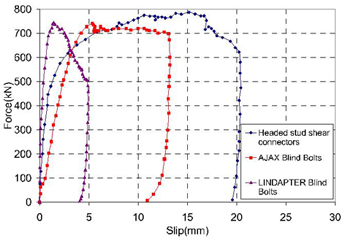
Figure 1: Comparison of load-slip relationships for headed stud shear connectors, AJAX bolts and LINDAPTER bolts
It can be concluded that it is possible to construct portable composite steel-concrete structures. AJAX bolt tends to behave far better than the LINDAPTER bolt in terms of ultimate strength, stiffness and ductility. The AJAX bolt behaviour can be described as ductile behaviour. On the other hand, the LINDAPTER bolt behaviour can be described as brittle behaviour. According to design rules, shear connectors with sufficient ductility are considered the best. Therefore, from this paper, it can be concluded that the AJAX Bolts best suit as shear connectors in constructing portable structures. In order to implement this in practice, further research is required in comprehending both the behaviour of AJAX and LINDAPTER bolts.