
| doi:10.3850/978-981-08-6218-3_SS-We041 |
 Final Paper PDF Final Paper PDF
|
WEB CRIPPLING OF ALUMINIUM ALLOY SQUARE HOLLOW SECTIONS
F. Zhou1 and B. Young2
1Department of Building Engineering, Tongji University, Shanghai, China.
zhoufeng@tongji.edu.cn
2Department of Civil Engineering, The University of Hong Kong, Hong Kong, China.
young@hku.hk
EXTENDED ABSTRACT
A series of tests on aluminium square hollow sections subjected to web crippling is presented. A total of 112 web crippling tests were conducted. The web crippling tests were conducted under two loading conditions of end-two-flange (ETF) and interior-two-flange (ITF). The test specimens were fabricated by extrusion using 6063-T5 and 6061-T6 heat-treated aluminium alloys. The test specimens consisted of normal strength material (T5) with the 0.2% tensile proof stress (yield stress) ranging from 185 to 189 MPa, and high strength material (T6) with the 0.2% tensile proof stress ranging from 222 to 317 MPa. Twelve different section sizes were tested as shown in Table 1. A photograph of the ETF test setup is shown in Figure 2a. A servo-controlled hydraulic testing machine was used to apply a concentrated compressive force to the test specimens.
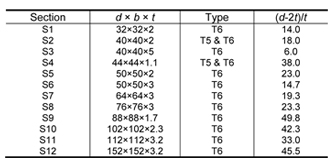
Table 1: Nominal Section Dimensions
A non-linear finite element model is developed and verified against the test results.The finite element program ABAQUS was used to simulate aluminium tubular sections subjected to web crippling. The bearing plates, aluminium tubular section and the interfaces between the bearing plates and the aluminium section have been carefully considered in the finite element model (FEM). The bearing plates were modeled using analytical rigid plates and the aluminium section was modeled using the S4R shell elements. The finite element mesh used in the model was investigated by varying the size of the elements in the cross-section to provide both accurate results and less computational time. The typical finite element mesh of the square hollow sections is shown in Figure 2b. Due to symmetry, only one half of the specimen was modeled, as shown in Figure 2b. The interfaces between the bearing plates and the aluminium section were modeled using the contact pair. The steel bearing plates are the master elements, while the aluminium specimen is the slave element of the interface elements in the FEM. The contact pair allows the surfaces to separate under the influence of a tensile force. However, the two contact surfaces are not allowed to penetrate each other.
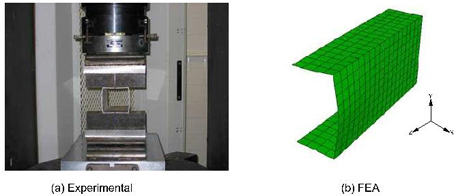
Figure 2: Comparison of experimental and finite element analysis for end-two-flange (ETF) loading condition
A comparison between the experimental results and the finite element results was carried out. The main objective of this comparison is to verify and check the accuracy of the finite element model. It can be seen that good agreement has been achieved between both results for all specimens. The mean value of the PExp/PFEA ratio is 0.98 with the corresponding coefficient of variation of 0.057. A maximum difference of 9% was observed between the experimental and numerical results for specimen ETF-S2T6-N25. The web crippling failure mode observed from the tests has been also verified by the finite element model. Figure 2 shows the failure mode observed from the test and predicted by finite element analysis for ETF loading condition. It is shown that good agreement between the experimental and finite element results for both the web crippling strength and failure mode.
An experimental investigation of aluminium square hollow sections subjected to web crippling has been presented. The test specimens were tested under end-two-flange and interior-two-flange loading conditions. The flanges of the square hollow sections were not fastened to the bearing plates. The new web crippling test data presented in this paper can be used to develop design rules for aluminium square hollow sections. A finite element model that incorporated the geometric and material non-linearities has been developed and verified against the experimental results. The finite element model closely predicted the behaviour of aluminium square hollow sections subjected to web crippling.