
| doi:10.3850/978-981-08-6218-3_SS-We024 |
 Final Paper PDF Final Paper PDF
|
CYCLIC BEHAVIOUR OF STEEL BEAM-TO-BOX COLUMN CONNECTIONS WITH COVER PLATES
Ker-Chun Lin1,a, Sheng-Jhih Jhang1,b and Heui-Yung Chang2
1National Center for Research on Earthquake Engineering, Taipei, Taiwan.
akclin@ncree.org.tw
bsjjhuang@ncree.org.tw
2Department of Civil and Environmental Engineering, National University of Kaohsiung, 700, Kaohsiung
University Rd., Nanzih District, Kaohsiung 811, Taiwan.
hychang@nuk.edu.tw
EXTENDED ABSTRACT
For steel moment connections, a beam-to-column connection with cover plates is one of the most effective enlarged beam section connections to transfer beam moment to column. As long as meeting a design principle of reducing the beam stress at column face and expected beam plastic hinge being away from column and well joint details, it is able to stably develop inelastic deformation. This paper presents investigated efforts of five full-scale steel beam-to-box column connections using cover plates subject to cyclic increased loading suggested by AISC’s seismic provisions. The material of them uses SN490B whose properties of strength, toughness and welding are stricter than A572 GR50. Two diaphragms within the box column were welded by one pair of electro-slag welding (ESW) and the other pair of fully penetration welds (FP) by SMAW or FCAW. For all specimens, the diaphragms and the beam flanges had identical thickness and same levels. There were two specimens that their specimen beams connect to the box column faces whose back was ESW, and the other three specimens were connected to the column faces whose back was FCAW. All specimens were designed to follow the previous mentioned design but Specimen CR1. Experimental results indicated that the beam-to-column connection with cover plates had excellent inelastic strength and deformation performances if they follow the design principle and fabricated details proposed in this paper. The deformation capacities of interstory drift and plastic rotation of the connections were capable of being up to 6% and 4.26% radians, respectively, without any fracture to reduce connection resistance. The plastic strength of the beam with an average strain hardening factor of 1.23 at a tip of the cover plate was measured. Nevertheless, premature fractures were found at two specimens that the beam flanges welded to the column faces with ESW at backs. The factures concentrically located at the interface between ESW and column plate. The issue of improving the strength and deformation performances at joint of the ESW and the box column plate is still going on.
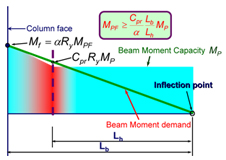
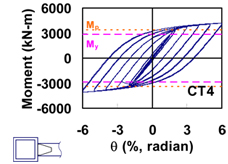
This paper also emphasizes the importance of design consistence on strength demand and strength capacity for the steel beam-to-box column connections with cover plate, as shown in Figure 3. Otherwise, unreasonable design results and unexpected behaviours of beam-to-column connections will be found. Some essential information of the specimens present in Table 1 and Figure 4. Excellent seismic performances of the steel beam-to-box column connections on moment strength and deformation angle are shown in Figure 7. Also, a lesson that the ESW between internal diaphragm and column plate within the box column occur brittle fracture (Figure 8) should be noted.
 |
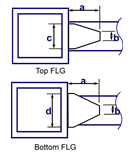 |
Figure 3: Design principle of seismic beam-to-column connections |
Figure 4: Design variables of the cover plates |
Table 1 Parametric table of specimens
 |
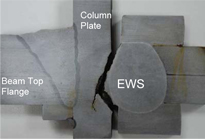 |
Figure 7: Typical relationship of beam end moment and interstory drift angle |
Figure 8: Fractured situation of ESW between column plate and diaphragm of Specimen CT1 |