
| doi:10.3850/978-981-08-6218-3_SS-We014 |
 Final Paper PDF Final Paper PDF
|
PUNCHING SHEAR STRENGTH OF EDGE COLUMNS IN ENERGY DISSIPATION STRUCTURAL WALLS (EDSWS)
Nasruddin Junus1,a, Kenji Sakino2, Hiroyuki Nakahara3, Hiroki Matsubayashi1,b
1Student, Depart.of Architecture, Kyushu Univ., Japan.
anasruddin_09g@web5.arch.kyushu-u.ac.jp
bmats19860118@yahoo.co.jp
2Professor, Depart.of Architecture, Kyushu Univ., Japan.
sakino@arch.kyushu-u.ac.jp
3Associate Professor, Depart.of Architecture, Kyushu Univ., Japan.
nakahara@arch.kyushu-u.ac.jp
EXTENDED ABSTRACT
This paper discusses the punching shear strength of edge columns in Energy Dissipation Structural Walls (EDSWs) which were proposed as new composite structural walls by authors. Hysteretic behaviour of EDSWs has been experimentally investigated and reported elsewhere. It is clarified that EDSWs behave in a very ductile manner under cyclic lateral loading, and have an ample energy dissipation capacity. It was also reported that indications of any kind of shear failure were not observed in both of the concrete wall panels and plastic hinges developed at the bottoms of the reinforced concrete edge columns confined in square steel tube. However, it is still concerned that a kind of brittle failure of the reinforced edge columns, such as punching shear failure, could be occurred under some structural conditions. In order to propose a design method to prevent such brittle failure, it is necessary to establish a calculation method for the punching shear strength. The objective of this paper is to experimentally clarify the potential punching shear strength of edge columns under the similar loading condition of edge columns in EDSWs. The experimental program was planned to investigate the effects of concrete strength, amount of longitudinal steel bars and magnitude of axial load on punching shear strength of the edge columns. Twenty one specimens were tested. These were divided into two series which were called as compression series and tension series.
1. INTRODUCTION
The desirable mechanism of structural wall system, which can overcome inherent defects of each failure mechanism, was proposed by Sakino et.al. (2004) and named as Energy Dissipation Structural Walls (EDSWs). The experimental results proved that EDSWs behaved in a satisfactory manner from the viewpoint of basic structural demands, i.e., stiffness, strength and energy absorption capacity (Sakino and Hitaka, 2006). A main structural problem, which EDSWs might have, is a possible punching shear failure after flexural yielding occurred in plastic hinges of reinforced concrete edge columns developed at the bottom of EDSWs.
2. EXPERIMENTAL PROGRAMS
The experimental program was planned to investigate a punching shear capacity of bottom edge columns of EDSWs, which was confined in square steel tube (referred to as TRC, which was an abbreviation for Tubed Reinforced Concrete, hereafter) columns. Twenty one specimens were tested. Fifteen specimens were tested under compression or zero axial force. Six specimens were tested under tension force. The variable parameters of the experiment are magnitude of axial force, amount of longitudinal bars and concrete strength. A loading apparatus is shown in Figure 1. The axial force which was kept constant during the experiment was applied to specimens by a hydraulic jack set vertically. The lateral force was applied to specimens in a manner of pushing in one side only until the horizontal displacement of the specimen reached 20 mm. A characteristic of the loading apparatus is that a rotational angle of the top of the specimen is limited to a certain value by the specially designed device referred to as rotation-restraint device, which was composed of a steel shape beam, load cell, and rollers.
3. EXPERIMENTAL RESULTS AND DISCUSSION
Figure 2 shows relationships between lateral force and horizontal displacement which is defined as relative displacement between lateral loading point and foundation beam. In the case of many specimens, descending curves terminate at certain displacements which depend on the experimental parameters. In almost all specimens with larger amount of longitudinal bars, lateral loads increase again, and reach the second peak value of lateral load. The second peak value is larger than the first peak value in many specimens shown in Figure 2b) and c). The breakdowns of longitudinal bars were observed in some specimens with smaller amount of longitudinal bars, which resulted in abrupt decrease of lateral load. The measured largest shear span ratio at the first peak point is 0.44 which is very small compared to that of ordinal moment resisting frame columns. The shear failure capacity of the columns with very small shear span ratio is usually called as punching shear capacity. The experiment results show that the punching shear capacity is affected by all the experimental parameters. In addition, average values of ratio of experimental results and calculated results using two methods are almost the same value of 1.5. This means that the punching shear capacities of TRCs are 1.5 times larger than those of ordinary reinforced concrete columns due to confinement effect of square steel tube with vertical stiffener.
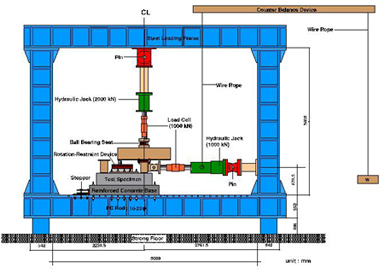
Figure 1: Loading apparatus
4. CONCLUSIONS
Behaviour of reinforced concrete short columns confined by steel tube (TRC columns) which failed in punching shear after flexural yielding was able to be observed by using the experimental apparatus with the rotation-restraint device which limited the rotation at a column top as predetermined value. The punching shear strength was affected mainly by magnitude axial load, amount of longitudinal steel bars and concrete strength. Punching shear capacity of TRC columns was 1.5 times larger than those of ordinary reinforced concrete columns which were estimated by experimental formula using in Japan.
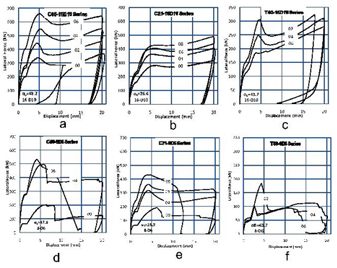
Figure 2: Relationships between Lateral Force and Horizontal Displacement