
| doi:10.3850/978-981-08-6218-3_SS-We010 |
 Final Paper PDF Final Paper PDF
|
CYCLIC TESTING OF TUBULAR STEEL BRACES WITH CFRP REINFORCED NET SECTIONS
C. Haydaroglu1,a, A. Turker1,b, K. Taskin2 and O. C. Celik3
1Institute of Science and Technology, Istanbul Technical University, Istanbul, Turkey.
acem.haydaroglu@hotmail.com
bgigadem@hotmail.com
2Civil Engineering Faculty, Istanbul Technical University, Istanbul, Turkey.
taskinkiv@itu.edu.tr
3Faculty of Architecture, Istanbul Technical University, Istanbul, Turkey.
celikoguz@itu.edu.tr
EXTENDED ABSTRACT
To improve the hysteretic behavior and early net section fracture of tubular braces, CFRP members often used in seismic retrofit projects could be used to delay or prevent net section failures. To investigate the validity of such a solution, three specimens have been designed and cyclically tested in the Structural and Earthquake Engineering Laboratory (STEEL) of Istanbul Technical University. Square tube braces were tested under quasi-static displacement histories. Although a few previous studies proposed the use of composite members to seismically retrofit steel members, the idea of using combined CFRP laminates and sheets around net sections of tubular steel braces is quite “new” and has not been proved experimentally yet.
This paper reports on the cyclic inelastic behavior of partially CFRP wrapped tubular steel braces. The obtained strength, stiffness, maximum displacement ductilities and cumulative dissipated energies are compared. Experimental results show that, at the same ductility levels, the cumulative energy dissipation of braces can be significantly increased when CFRP members are used.
The major conclusions from this experimental study are as follows:
- Brace to gusset net sections of steel braces may undergo early fracture depending on non-ductile detailing.
- As an alternative to steel plate welding, to improve ductility without significantly increasing axial strength and stiffness, CFRP laminates and sheets could be used.
- Using dissipated hysteretic energy to compare the relative effectiveness of the selected specimens showed that braces with combined CFRP laminate and sheet reinforcement (TB-3) had better hysteretic energy dissipation capacity.
- The proposed technique is promising for use in tubular steel braces that lack sufficient ductility.
EXPERIMENTAL OBSERVATIONS
The inelastic behavior of each specimen is given below. For each case experimental base shear versus lateral drift hysteresis, buckled shapes of braces and damage levels (yielding, buckling, CFRP debonding, or local fracture) are shown in Figure 1.
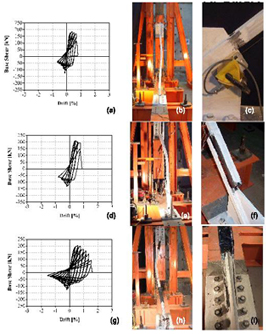
Figure 1: Base shear vs. drift hysteresis curves for specimens (a) Hysteresis of TB-1; (b) Buckled shape of brace at -2δy; (c) Fracture of net section; (d) Hysteresis of TB-2; (e) Buckled shape of brace at -3δy; (f) Debonding of CFRP laminate and fracture of net section; (g) Hysteresis of TB-3; (h) Buckled shape of brace at -5δy; (i) Debonding of lower gusset CFRP laminates.