
| doi:10.3850/978-981-08-6218-3_SS-Th044 |
 Final Paper PDF Final Paper PDF
|
STRENGTHENING OF ALUMINIUM HOLLOW SECTIONS SUBJECTED TO END-TWO-FLANGE LOADING
S. M. Z. Islama and B. Youngb
Department of Civil Engineering, The University of Hong Kong, Hong Kong, China.
azahurul@hkusua.hku.hk
byoung@hku.hk
EXTENDED ABSTRACT
This paper describes an experimental program on aluminium tubular structural members which is experienced web crippling failure due to localized concentrated loads or reactions. A series of tests was performed on fibre-reinforced polymer (FRP) strengthening aluminium tubular structural members subjected to End-Two-Flange loading condition. A total of 42 web crippling tests was conducted. The investigation was mainly focused on the effects of different adhesive and FRP for strengthening aluminium tubular sections against web crippling. The test specimens consisted of 6061-T6 heat-treated aluminium alloy square and rectangular hollow sections. Six different adhesive and FRP were considered in this study. The properties of adhesive and FRP have significant influence on the effectiveness of the strengthening. Most of the strengthened specimens were failed by debondinig of FRP plates from the aluminium tubes. Four different failure modes were observed in the tests, namely the adhesion, cohesion, combination of adhesion and cohesion, and interlaminar failure of FRP plate. The failure loads, failure modes and the load-web deformation behaviour of the aluminium sections are presented in this study. It was found that the web crippling capacity of aluminium tubular sections are significantly increased due to FRP strengthening, especially for those sections with higher web slenderness ratio.
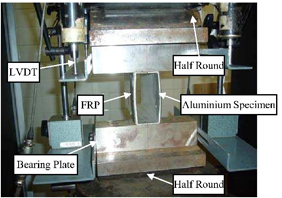
Aluminium tubular members have the advantages of light weight and corrosion resistance, which is increasingly used in structural applications in recent years. The modulus of elasticity of aluminium is about 1/3 of steel. The web crippling capacity often restricts the use of aluminium tubular members in structures. As compared with aluminium alloy, carbon-fibre-reinforced polymer (CFRP) has higher strength and modulus of elasticity along the fibre direction. Externally bonded FRP strengthening can be considered as an alternately solution for such aluminium structural members. Two FRP sheets of Sika Wrap-300C/60 (CFRP) and Sika Wrap-430G/25 glass-fibre-reinforced polymer (GFRP) were used. One layer of FRP sheet is wrapped outside the tubular aluminium. Four FRP plates of Tyfo UC laminate, Sika CarboDur S1214, Sika CarboDur M614 and Sika CarboDur H514 laminate plates were used. One layer of CFRP plate of 50mm is attached on both sides of the webs of the aluminium sections at the end of the specimen. In this study, the length of strengthening is identical to the length of the bearing length which is 50mm. Figures 2 and 3 show the test arrangement of ETF loading condition and failure of a specimen by combination of adhesion and cohesion failure, respectively.
 |
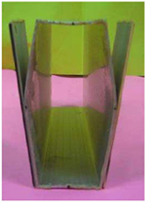 |
Figure 2: Test setup of End-Two-Flange loading condition |
Figure 3: Combination of adhesion and cohesion failure |
According to the experiments, it is shown that the high modulus CFRP Sika CarboDur H514 laminate plate (f) delivered the best performance for the tested aluminium sections as shown in Figure 4. The different failure modes such as cohesion, adhesion, combined adhesion and cohesion, and interlaminar failure of CFRP plate were observed in this investigation. It was found that as slenderness ratio (h/t) increases, the web crippling load enhancement also increases. For aluminium sections A76x76x3, A100x45x3 and A100x45x1.6 of measured slenderness values of 22.8, 31.9 and 61.4, the web crippling load enhancement was found to be 23%, 34% and 187%, respectively. The adhesive Araldite 2015 (E) and the high modulus Sika CarboDur H514 laminate plate (f) showed the better performance for strengthening of aluminium tubular sections subjected to End-Two-Flange loading condition.
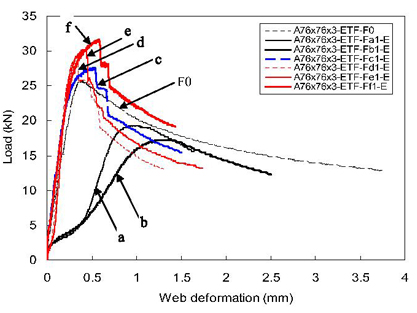
Figure 4: Comparison of different FRP effects on load-web deformation behaviour of A76x76x3-ETF-E specimens