
| doi:10.3850/978-981-08-6218-3_SS-Th034 |
 Final Paper PDF Final Paper PDF
|
STATIC STRENGTH OF SQUARE TUBULAR T-JOINT UNDER AXIAL COMPRESSION WITH COLLAR-PLATE REINFORCEMENT
Y. B. Shao1,a, Y. Q. Cai1 and S. P. Chiew2
1School of Civil Engineering, Yantai University, Yantai, P. R. China.
acybshao@ytu.edu.cn
2School of Civil & Environmental Engineering, Nanyang Technological University, Singapore.
cspchiew@ntu.edu.sg
EXTENDED ABSTRACT
The stiffness of the chord in radial direction is generally much weaker than the axial stiffness of the brace in a square tubular T-joint with thin-walled hollow section, and the chord surface near the weld toe becomes the failure location in most cases. To improve the stiffness in transverse direction of the chord, collar plate can be used. The collar plate is welded onto the chord surface and to the brace/chord intersection. Through the reinforcement of the collar plate, the load bearing capacity of the joint can be improved. In this paper, the static strength of collar-plate reinforced squared tubular T-joints under axial loading is analyzed through both theoretical analyses and finite element simulation. In the theoretical analysis, yield line theory is used to present the equation for predicting the static strength of a collar-plate reinforced tubular T-joint. The accuracy of the proposed equation is then verified from numerical results. The reliability and accuracy of the presented equation, as well as its validity of the application range, are evaluated.
1. YIELD LINE THEORY FOR COLLAR PLATE REINFORCED T-JOINT
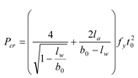
The yield line theory for predicting the static strength of a square tubular T-joint is suitable when the wall thickness of the joint is very thin and the flexural stiffness of the collar plate is much higher. The critial load Pcr of the collar plate reinforced square tubular T-joint is expressed as following equation
2. EVALUATION OF THEORETICAL EQUATION
To verify the reliability and the accuracy of the presented equation for predicting the static strength of a collar plate reinforced square tubular T-joint under axial compression, finite element analyses on several models are analyzed. Table 1 gives the detailed information on the analyzed collar plate reinforced T-joint models.
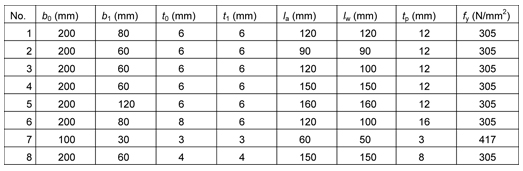
Table 1: Detailed information of the analyzed models
The static strengths of the models in Table 1, expressed as the critical load, can be obtained both numerically and theoretically. The results are tabulated in Table 2. In Table 2, Pe is the theoretical result which is calculated from equation, and Pn is the finite element result. It can be seen from the comparison between Pe and Pn that the theoretical values of the critical load agree with numerical values reasonably well. Generally, theoretical equation can provide accurate estimation when the chord thickness is much smaller. For model 7, the difference between theoreticl value and numerical value is slightly bigger because the chord thickness is bigger.
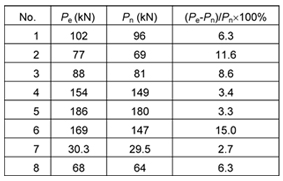
Table 2: Critical loads
3. CONCLUSIONS
The static strength of a collar plate reinforced square tubular T-joint under axial compression can be calculated through yield line theory with reasonable accuracy when the flexural stiffness of the collar plate is big enough. However, the suitable thickness of the collar plate is still necessary to be studied in further investigation.
4. ACKNOWLEDGEMENT
This research work is supported by National Science Foundation of China (No. 50808153), and such support is greatly appreciated by the authors.