
| doi:10.3850/978-981-08-6218-3_SS-Th016 |
 Final Paper PDF Final Paper PDF
|
LOAD CARRYING CAPACITY OF HIGH STRENGTH COLD-FORMED STEEL BUILT-UP BOX SECTIONS
H. H. Laua and T. C. H. Tingb
Department of Civil & Construction Engineering, Curtin University Technology Sarawak Campus, Miri, Sarawak, Malaysia.
alau.hieng.ho@curtin.edu.my
btina.ting@stud.curtin.edu.my
EXTENDED ABSTRACT
This paper presents an experimental study of the cold-formed steel built-up box sections in compression. The built-up box sections are formed by two identical simple C-lipped channels connected at their flanges with self-drilling screws. The specimens were compressed between fixed end conditions for stub columns and also for intermediate columns. The column test strengths were compared with the theoretical design strengths, which were calculated using the Effective Width Method (EWM) and also the Direct Strength Method (DSM). Three analytical models were proposed for the compressive strength prediction of the built-up box section. Results from the study show that Effective Width Method predicts the compressive strength of built-up box sections better than Direct Strength Method. Proposed analytical model 1 results for stub columns and model 2 results for intermediate columns correlates well with the experimental results.
1. SUMMARY
Local industry has created a new configuration for the built-up box section by connecting two C-Channels of the same size face to face and pushing them into position as shown in Figure 1. The current North American Specification (NAS) [1] for the Design of Cold-Formed Steel Structural Members does not provide any specific guidelines for this built-up box section configuration. The stress distribution in the elements of the box section might be affected during the production process, especially when the sections are pushed into position. This can potentially lead to a change in behaviour and also carrying capacity of the built-up box section compared to the sum of the capacities of the individual members that make up the assembly. To address these problems, the behaviour of this type of built-up box sections under compression needs to be understood.
In this study, the theoretical axial compressive strengths of the cold-formed steel sections are determined using the Effective Width Method (EWM) and Direct Strength Method (DSM). Direct Strength Method (DSM I) carried out in this paper used manual elastic buckling calculation instead of other numerical methods. Three analytical models are proposed with different thicknesses at certain areas to simulate the different degree of restraint among the box sections. The three analytical models are built-up box section with lips (Model 1), built-up box section without lips (Model 2) and box section with double the thickness (Model 3) as shown in Figure 2.
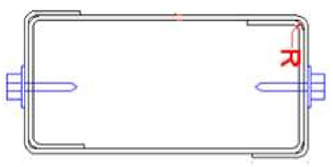
Figure 1: Built-up Box Sections
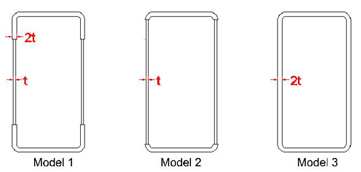
Figure 2: Proposed Analytical Models
Test specimens were made from two simple C-lipped channels connected at their flanges, using self-drilling screws spaced at 100mm, to form the built-up box sections. Each section was cut to lengths of 450mm and 1500mm. A total number of 16 specimens were tested in this study. In this paper, the material’s properties used for EWM and DSM calculation are based on the average yield stress, fy of 550MPa and the Young’s Modulus, E of 205GPa. The theoretical strength calculated using EWM (PEWM), and DSM I (PDSMI) are compared to the experimental compressive strength (PTEST). Analysis of each design approach was carried out using the three proposed analysed models.
The stub column compression test was carried out using the GOTECH, GT-7001-LC60 Universal Testing Machine (UTM) with a capacity of 600kN. Two 12.5mm end thick plates were welded to the ends of the specimen. The rigid flat end of the specimen was considered fixed. One Linear Variable Differential Transducer (LVDT) was positioned at the mid-span of the specimen. The intermediate column compression test was carried out using a 500kN capacity hydraulic jack. A small pre-load is applied to the specimen to ensure the endplates are in full contact with the specimen end plates. Two LVDT’s were positioned at mid span and at the top of the specimen for mid span deflection and axial shortening.
The study found that Effective Width Method predicts the compressive strength of built-up box sections better compared to Direct Strength Method. In addition, the strength predictions based on Model 1 for stub columns and the strength predictions of built-up box section using Model 2 for intermediate columns correlate well to the experimental results. The carrying capacity of the built-up box section is more than the sum of the capacities of the individual members that make up the assembly in both stud and intermediate columns.