
| doi:10.3850/978-981-08-6218-3_SS-Th009 |
 Final Paper PDF Final Paper PDF
|
NUMERICAL MODELLING OF SEMI-RIGID OPEN BEAM-TO-TUBULAR COLUMN CONNECTIONS
Y. Liua, C. Malaga-Chuquitaypeb and A. Y. Elghazoulic
Department of Civil and Environmental Engineering, Imperial College London, UK.
ayanzhi.liu08@imperial.ac.uk
bc.malaga-chuquitaype07@imperial.ac.uk
ca.elghazouli@imperial.ac.uk
EXTENDED ABSTRACT
Hollow structural sections (HSS) feature inherit architectural and structural advantages over other structural steel sections. In particular, their higher strength to weight ratio and improved torsion stiffness make HSS ideal for use as column members. However, the difficulties associated with connecting open-beams and tubular columns may sometimes hamper its wider application in practice. Besides, most of the attention up to date has been concentrated on fully-rigid fully-welded connections, resulting in relatively limited design guidance available on bolted angle connections for tubes. In this context, this paper presents numerical predictions of the monotonic rotational response of blind bolted open beam-to-tubular column angle connections
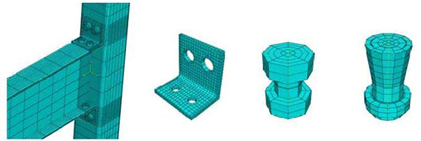
Figure 1: Initial shape of connection and components in the finite element model
The proposed continuum finite element models were developed in the general purpose package ABAQUS. Eight-node solid elements were used to model various connections components such as angle cleats, universal beam, tubular column, blind bolts and standard bolts components, as shown in Figure 1. Importantly, the contact effects between the surfaces of all components was taken into account by defining ‘hard and friction’ surface interaction properties and by considering slippage between the bolt and hole surfaces. Moreover, the bolt pretension load was incorporated by means of two loading steps, firstly applying force and secondly adjusting the bolt length, followed by the third step for applying external force. The boundary conditions and loading in the numerical analyses followed the experimental conditions and loading methods. A typical example including the deformation and stress distribution of the connection and its components at the ultimate state is shown in Figure 2.
These FE models were validated against available experimental data and good comparisons were obtained, as shown in Figures 3 and 4. The component behaviour and the overall moment-rotation response at pre-yielding and post yielding load levels were closely represented by the analysis. This agreement with the tests shows that the detailed FE model can adequately simulate the actual response of blind bolted angle connections.
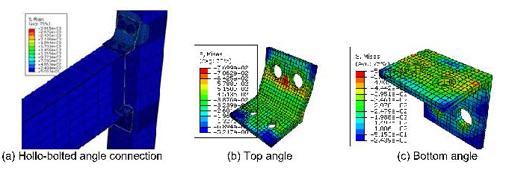
Figure 2: Deformed shape and stress distribution of Connection A10-d65-G8.8-M at the ultimate load
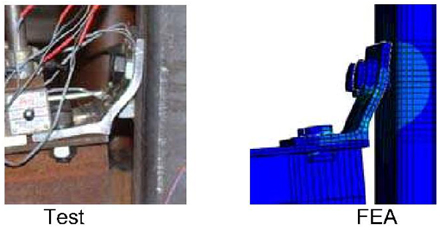
Figure 3: Comparison of deformation of top angle from experiment and FE analysis for A10-d65-G8.8-M
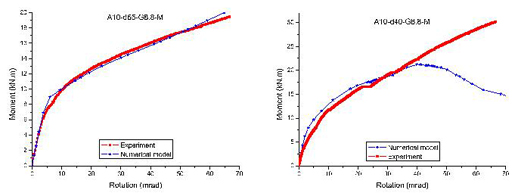
Figure 4: Comparison of connection force-displacement curve from experiment and FE analysis
This work constitutes a fundamental step towards the development of analytical tools for assessing of the behaviour of open beam-to-tubular column connections under a wider range of loading scenarios with a view to providing improved design guidance for these configurations.