
| doi:10.3850/978-981-08-6218-3_SS-Fr045 |
 Final Paper PDF Final Paper PDF
|
EXPERIMENTAL INVESTIGATION OF POST-TENSIONED COLUMN BASE CONNECTION
H. Chia and J. Liub
School of Civil Engineering, Purdue University, West Lafayette, IN, USA.
ahchi@purdue.edu
bjliu@purdue.edu
EXTENDED ABSTRACT
Column bases in self-centering steel moment resisting frames (SC-MRFs) may suffer damage (e.g., plastic hinging) for a major earthquake. This structural damage results in permanent residual deformations of column bases and affects the self-centering capability of the SC-MRFs. In order to eliminate the structural damage of column bases, post-tensioned (PT) column base connections are introduced at column bases in SC-MRFs. The PT column base connection consists of PT high strength bars for clamping and restoring forces, buckling restrained steel plates for energy dissipation and damping, reinforcing plates for increasing bearing and shear yielding resistance, and Keeper plates for additional shear resistance. Buckling restrained plates and Keeper plates are welded together. In this paper, the cyclic behaviour of the PT column base connection is investigated experimentally. This paper presents the test results of the post-tensioned (PT) column base connection subassemblies subjected to cyclic lateral displacement and axial loading. The test results include lateral load-displacement response, connection moment-relative rotation response and post-tensioned bar behaviour. For most tests, PT column base connection specimens showed stable hysteretic behaviour without structural damage in beams and columns. Also, properly designed PT column base connections were able to withstand 4% drift without strength degradation.
1. TEST SPECIMEN AND TEST RESULTS
Figure 1 shows details of one of the post-tensioned column base test specimens. W18x86 columns and beams were used. Four high strength bars were anchored between half-height of the column to close to the bottom of the grade column. For energy dissipation, buckling restrained steel (BRS) plates with a reduced section were bolted to column flanges and grade beam flanges. Cover plates were used to prevent the global buckling of the BRS plates. Two reinforcing plates were welded to column flanges. Keeper plates were bolted to grade beam flanges to help with shear force transfer. The Keeper plate has a 5 degree bevel to allow column rotation without restraint.
In the PTC-1 test, initial axial load and quasi-static, cyclic loading was applied according to the AISC loading protocol. The maximum lateral displacement of the specimen was 2.9 inches, which corresponded to 4% drift.
The lateral load vs. drift response and moment vs. relative rotation response of test PTC-1 are shown in Figure 2 (a) and Figure 2 (b), respectively. It is seen that the PT column base connection withstands 4% drift without strength degradation. Also, the connection shows negligible residual rotation after the test. At 0.5% drift, the BRS plate began to yield. During 3% drift cycles, slight yielding was observed locally in the panel zone. During 4% drift cycles, no significant yielding was observed in the column and beam during the test.
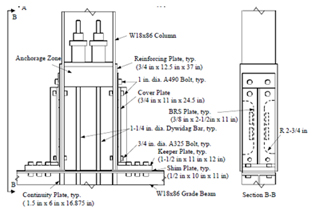
Figure 1: Details of PT column base connection
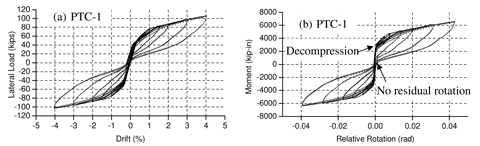
Figure 2: Lateral load vs. drift and Moment vs. relative rotation
2. CONCLUSIONS
Post-tensioned (PT) column base connection subassemblies were subjected to cyclic lateral displacement and axial loading. For most tests, PT column base connection specimens showed stable hysteretic behavior without structural damage in beams and columns. Properly designed PT column base connections showed self-centering capability. Residual rotation at the column base was negligible after tests. The strength and stiffness of the PT column base connection were associated with initial PT force and initial axial force in the column.