
| doi:10.3850/978-981-08-6218-3_SS-Fr041 |
 Final Paper PDF Final Paper PDF
|
NONLINEAR NUMERICAL SIMULATION OF FLUSH END-PLATE CONNECTIONS IN FIRE
R. Y. Xiaoa, Z. W. Gong and C. S. Chin
School of engineering, Swansea University, Swansea, UK.
aR.Y.XIAO@swansea.ac.uk
EXTENDED ABSTRACT
1. INTRODUCTION
Flush end-plate connections are widely used for connecting beams to columns in steel structures. A typical flush end-plate connection consists of a rectangular steel plate of nearly the same depth as the beam depth and is welded to the beam end. The assembly is then bolted to the flange of a column by structural steel bolts. Many experimental tests have been conducted in the last decades to study the effect of dynamic load and service load on flush end-plate, however, very little information on the behaviour of flush end-plate in fire conditions had been disseminated. In this research, the flush end-plate beam-to-column connections are being investigated in fire conditions.
2. VALIDATING THE FINITE ELEMENT MODEL
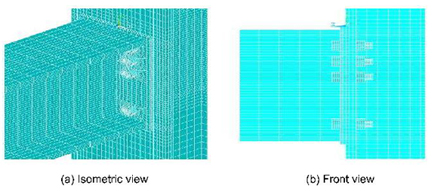
Figure 1: 3-D finite element model of the connection
A 3-D finite element model (Figure 1) of a flush-end plate connection was developed in order to analyse and understand the behaviour of such a connection at elevated temperatures. The finite element results were compared with the experimental data generated by Al-Jabri [1, 2, 3, 4]. There are four elevated temperature tests were modelled, comparisons of the temperature-rotation response of the connection at different temperatures is shown in Figure 2. The results have shown a high degree of accuracy for computing modelling.
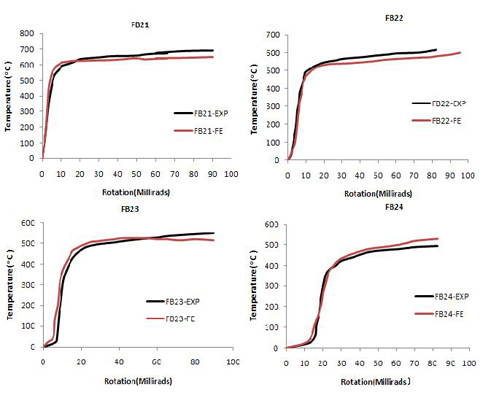
Figure 2: Comparison of finite element and experimental results for the tests
3. REFERENCES
[1] Al-Jabri KS, Burgess IW, Lennon T, Plank RJ. Moment-rotation-temperature curves for semi-rigid joints. J Construct Steel Res 61:281–303. (2005)
[2] T.C.H. Liu, Moment–rotation–temperature characteristics of steel/composite connections, Journal of Structional Engineering 125 (10) , 1188–1197 (1999)
[3] Rahman R, Hawilch R, M ahamid M. The effect of fire loading on a steel frame and connection. In: Brebbia CA, Wilde WP, editors. High performance structures and materials II. WIT Press; P. 307–16 (2004)
[4] Lawson RM. Behaviour of steel beam-to-column connections in fire. Struct Eng 1990;68(14):263–71.