
| doi:10.3850/978-981-08-6218-3_SS-Fr034 |
 Final Paper PDF Final Paper PDF
|
AN EVALUATION OF PRESTRESSED STAYED STEEL COLUMNS LOAD BEARING CAPACITY WITH BAYESIAN NEURAL NETWORKS
R. R. Araujo1,a, P. C. G. S. Vellasco1,b, M. M. B. R. Vellasco2, S. A. L. Andrade3, L. R. O. Lima1,c, J. G. S. Silva4
1Structural Engineering Department, State University of Rio de Janeiro, UERJ, Brazil.
arraraujo@eng.uerj.br
bvellasco@eng.uerj.br
cluciano@eng.uerj.br
2Electrical Engineering Department, Pontifical Catholic University of Rio de Janeiro, PUC-Rio, Brazil.
marley@ele.puc-rio.br
3Civil Engineering Department, Pontifical Catholic University of Rio de Janeiro, PUC-Rio Brazil.
andrade@puc-rio.br
4Mechanical Engineering Department, State University of Rio de Janeiro, UERJ, Brazil.
jgss@eng.uerj.br
EXTENDED ABSTRACT
Prestressed stayed steel columns have been studied over the years by various investigators but the complete understanding of its structural behaviour it is still not fully understood. These extremely slender structures are very efficient due to their fast erection, lightness, malleability, resistance and their aesthetically attractive nature. Various geometrical layouts can be used enabling the system to sustain a wide range of load levels and lengths with economic and reliable structural solutions. A numerical study of these structures, using the Finite Element Method, was performed by varying the magnitude of the most relevant parameters. However the large number of required analyses needed to fully represent their effects pointed out for the use of Neural Networks to reduce the required number of finite element simulations. Neural Networks were then employed in this work to extend the prestressed stayed steel columns parametric analysis focusing on determining their load bearing capacity. The training and test data used by the neural networks were obtained from non-linear finite element simulations with the aid of the Ansys program. Due to the small number of available training data, Bayesian Neural Networks were subsequently employed, producing very accurate results when compared to the finite element simulations, without the high computational cost associated to the later. A particular case of these structural systems is composed of a slender central column, four cross bars perpendicularly positioned in relation to the central column main axis and four stays. To generate the training data set, design of experiments fundaments were used, where the parametric analysis was designed to represent the required variables space with a smaller number of analyses. The standard topology for all network configurations consisted of five input data, one hidden layer and one output data. The Bayesian Neural Networks proved to be a very useful computational intelligence tool for enlarging this type of parametric analysis without the need of hundreds of time-consuming non-linear finite element analysis that not always converge. Properly trained networks proved to be very efficient for improving the parametric analysis of prestressed stayed steel columns load bearing capacity in an easy and simple form.
1. INTRODUCTION
The aim of this paper is to present the experimental design, essential for building up a representative to meet all possible variables of prestressed stayed column, and using the test results of the Bayesian Neural Network to predict critical loads and were calibrated against nonlinear finite element simulations.
2. RESULTS
The table below represent the best results obtained with the various settings of Bayesian Neural Networks. The results are calculated in terms of MAP and RMS

Table 1: Configuration 2: 1st Normalization strategy - using noise in inputs and outputs.
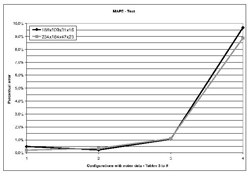
Figures 1 and 2 depicts the lowest test values results for the RMS and MAP errors associated to the neural network configurations presented in tables 3 to 6. It is evident from the graphs that the best neural network performance was related to the second configuration possessing noise in input and output data that used the first standardization strategy (maximum and minimum). This was accomplished with a 10 hidden layer network with 78 actual and 78 noisy data, totalizing of 156 data, where 70% was used for training, 20% for validation and 10% for testing.
 |
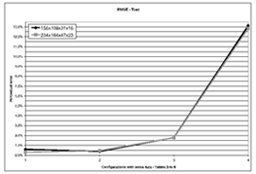 |
Figure 1: MAPE test result to configuration 2. |
Figure 2: RMSE test result to each configuration 2. |
3. CONCLUSION
This paper presented the results of Bayesian neural network simulations that achieved a better performance that Back-propagation neural network to determined the collapse load of prestressed stayed column systems. The associated error were approximately equal to 0,5%, that can be considered excellent in structural engineering problems. However it is fair to observe that this performance was reached with the use of additional noise data, doubling or even tripling the original data base. It is also important to state that the use neural networks to enlarge the original dataset proved to be very efficient without requiring the use of complicated computational models, which not always converge. The Bayesian neural networks proved to be extremely efficient for use in structural engineering problem that requires a parametric analysis.