
| doi:10.3850/978-981-08-6218-3_SS-Fr027 |
 Final Paper PDF Final Paper PDF
|
MATERIAL AND GEOMETRIC NON-LINEAR ANALYSIS OF PERFORATED THIN-WALLED STEEL STRUCTURES BY THE ISOPARAMETRIC SPLINE FINITE STRIP METHOD
Z. Yaoa, K. J. R. Rasmussenb
School of Civil Engineering, The University of Sydney, Sydney, NSW, Australia.
azhenyu.yao@sydney.edu.au
bkim.rasmussen@sydney.edu.au
EXTENDED ABSTRACT
This paper presents the application of the isoparametric spline finite strip method (ISFSM) to the material inelastic and geometric nonlinear analysis of perforated thin-walled steel structures. The general theory of the ISFSM and the numerical methods to compute plasticity are briefly introduced. A collapse analysis of a perforated storage rack upright is presented as an example to illustrate the accuracy and numerical efficiency of the proposed method.
1. INTRODUCTION
The isoparametric spline finite strip method (ISFSM) was developed from the semi-analytical finite strip method (FSM) which is an efficient tool for analysing structures with constant properties along the longitudinal direction. Using splines and isoparametric mapping, the ISFSM enhances the FSM by allowing much more complex loadings, geometries and boundary conditions. The ISFSM has been successfully applied to linear elastic, elastic buckling, and elastic geometric nonlinear analyses of perforated thin-walled structures. In the present paper, the ISFSM is further extended to the material inelastic and geometric nonlinear analysis of perforated thin-walled structures.
2. ISFSM ELASTO-PLASTIC ANALYSIS
The associated flow rule, specifically the Prandtl-Reuss flow rule, combined with the von Mises yield criterion and isotropic strain hardening, is used for the calculation of plastic strains. An implicit integration method, specifically the backward Euler return method is adopted for integrating the elasto-plastic stress-strain relations. The following effects can be considered in the present analysis:
- Holes of arbitrary shapes, sizes and locations.
- Large displacements but small rotations.
- Initial geometric imperfections.
- Arbitrary types of boundary conditions and loadings.
- Different types of material stress-strain relations for common metals, such as, ideal elastic-plastic, linear hardening and nonlinear (Ramberg-Osgood ) curves, etc.
- Material yielding through the thickness.
The Riks/Wempner linear arc-length method, combined with the ‘line-search’ technique and the ‘consistent material tangent modular’ technique, is adopted for solving the nonlinear equations. The numerical procedure thus obtained is capable of tracing complex equilibrium paths and handling nonlinear buckling problems.
3. EXAMPLE – COLLAPSE ANALYSIS OF A PERFORATED RACK UPRIGHT
A storage rack upright with patterned diamond holes under uniform compression is chosen for the collapse analysis using the ISFSM. The results are compared with those obtained using the FEM software ABAQUS and available experiment data.
Figure 1 compares the predicted and observed deformed shapes of the member at the ultimate load. The results show that the ISFSM produces almost the same deformed shape as that predicted by ABAQUS, and that the actual deformed shape observed in the experiment is generally in reasonable agreement with the predicted shape, featuring an inwards distortional buckle.
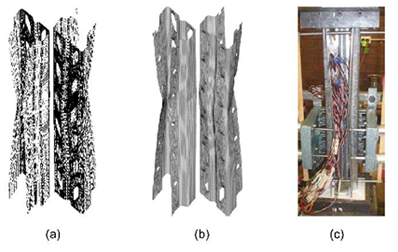
Figure 1: Final deformed shapes of the member: (a) ISFSM, (b) FEM, (c) experiment
 |
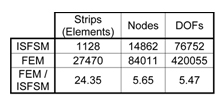 |
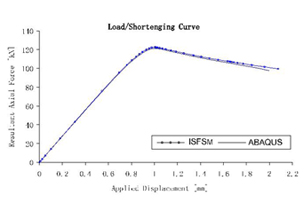
Figure 2: Load/shortening curve of the member |
Table 1: Mesh comparison between ISFSM and FEM |
Figure 2 shows the member load/shortening results of the present ISFSM and FEM analyses, demonstrating excellent agreement with a difference of 1.13% for the ultimate loads.
The geometric meshes for the ISFSM and the FEM are summarized in Table 1, it is clear that the ISFSM requires much less degrees of freedom (DOFs) than the FEM.