
| doi:10.3850/978-981-08-6218-3_SS-Fr024 |
 Final Paper PDF Final Paper PDF
|
DEFORMATIONALLY-INDUCED RESIDUAL STRESSES IN COLD-FORMED STEEL CIRCULAR HOLLOW SECTIONS: AN ANALYTICAL SOLUTION
W. M. Quacha and C. Cai
Department of Civil and Environmental Engineering, University of Macau, Macau.
awmquach@umac.mo
EXTENDED ABSTRACT
The manufacturing process of cold-formed steel sections induces cold work in members, which can subsequently affect the structural behaviour of the member. To assess the effect of cold work, residual stresses and equivalent plastic strains in cold-formed sections need to be quantified. This paper presents the results of research which forms part of a larger study on the predictions of residual stresses in cold-formed steel circular hollow sections. The manufacturing process of cold-formed steel circular hollow sections is illustrated in Figure 1. The paper is concerned with deformationally-induced residual stresses in roll-formed steel circular hollow sections, that arise from the cold-bending operations (including coiling, uncoiling, and transverse forming) of the manufacturing process before the longitudinal welding is applied. In this paper, an analytical model is presented for these residual stresses, in which each stage of the cold-bending operations is modelled as an elastic-plastic plane strain pure bending problem with the steel assumed to obey the von Mises yield criterion and the Prandtl-Reuss flow rule. To quantify the strain hardening induced by cold work, the prediction of equivalent plastic strains is also addressed in this model. The accuracy of the model is demonstrated by comparing its predictions with those from a finite element simulation. A parametric study has also been carried out to investigate the effects of forming parameters and mechanical properties on residual stresses (see Figure 2). Numerical results from this study allow the following conclusions to be made:
1. The outer surface of cold-formed steel circular hollow sections is subjected to tensile residual stresses, and the inner surface is subjected to compressive residual stresses.
2. The through-thickness variations of residual stresses are nonlinear.
3. The magnitudes of residual stresses and equivalent plastic strains in cold-formed steel circular hollow sections depend on the coiling radius, the forming radius and the initial yield strength of virgin steel sheets. Their magnitudes increase as the forming radius-to-thickness ratio R/t decreases. A higher initial yield strength generally lead to lower normalized residual stresses when normalized by the initial yield strength.
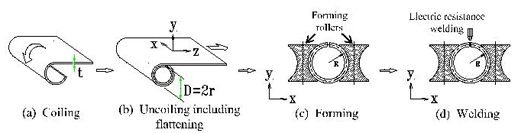
Figure 1: Manufacturing process of cold-formed steel circular hollow sections
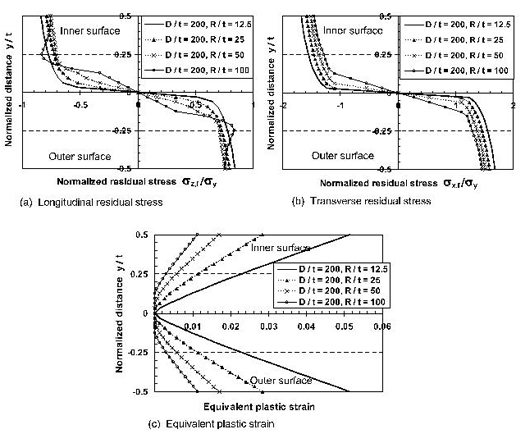
Figure 2: Through-thickness variations of residual stresses and equivalent plastic strains in cold-formed steel circular hollow sections: effect of R/t ratio