
| doi:10.3850/978-981-08-6218-3_SS-Fr013 |
 Final Paper PDF Final Paper PDF
|
DISTORTIONAL FAILURE AND DESIGN OF COLD-FORMED STEEL RACK-SECTION COLUMNS UNDER FIRE CONDITIONS
A. Landesmann1 and D. Camotim2
1Civil Engineering Program, COPPE, Federal University of Rio de Janeiro, Brazil.
alandes@coc.ufr.br
2Department of Civil Engineering and Architecture, ICIST-IST, TU Lisbon, Portugal.
dcamotim@civil.is.utl.pt
EXTENDED ABSTRACT
This work reports the available shell finite element results of an ongoing investigation on the distortional buckling, post-buckling and ultimate strength of simply supported cold-formed steel racksection columns subjected to axial compression and elevated temperatures due to fire conditions. The variation of the material behaviour with the temperature follows the EC3–1.2 model for coldformed steel, and the geometrically and physically non-linear shell finite element analyses are carried out in the code ANSYS. The influence of the temperature on the distortional post-buckling equilibrium paths and ultimate loads of the columns analysed simply is qualitatively and quantitatively illustrated in Figure 1. Each curve relates the applied stress σ, normalised with respect to σcr.D.20 (room temperature critical stress) to v/t (v is the mid-span flange-lip corner vertical displacement — positive inward) — the triangles stand for the ultimate stress ratios, whose values are also indicated.
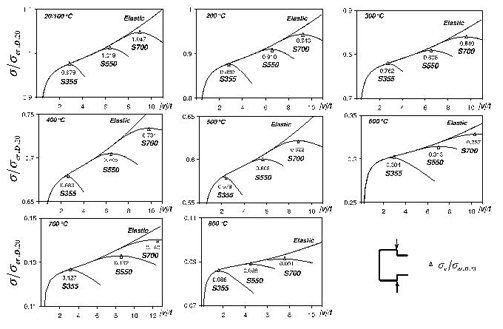
Figure 1: Distortional post-buckling equilibrium paths concerning columns made of 3 steel grades (S355, S550, S700) and subjected to different temperatures (20/100–200–300–400–500–600–700–800 °C)
Figure 2(a) shows the variation of the ultimate stress ratio σu.D.T/σu.D.20 with T for the three steel grades (dashed lines). Also depicted in is the variation of the critical stress ratio σcr.D.T/σcr.D.20 with T (solid line — the same for all steel grades). The table in Figure 2(b) gives the σu.D.T/σcr.D.T values, which provide the amount of post-critical strength reserve associated with each simulated column.
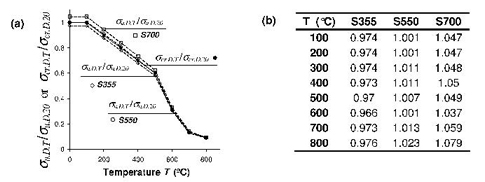
Figure 2: (a) Variation of σu.D.T/σu.D.20 and σcr.D.T/σcr.D.20 with T (dashed and solid curves, respectively) for the steel grades S355, S550 and S700, and (b) table providing the σu.D.T/σcr.D.T values of the columns analysed in this work.
The suitability of the Direct Strength Method to predict the load-carrying capacity of simply supported and fixed rack-section columns subjected to high temperatures and failing in distortional modes is also addressed in the paper. Figure 3 shows the preliminary results obtained — it compares the ultimate loads predicted by the current DSM distortional design curve, modified to account for the high temperature effects, with the values (i) obtained in this work (numerical) and (ii) reported by Ranawaka & Mahendran (2009) (experimental). Each plot is related to a different temperature and the ultimate loads obtained in this work concern a single column geometry and various room temperature yield stresses (σy=150−1200 MPa), making it possible to cover a distortional slenderness range comprised between 0.84 and 3.18.
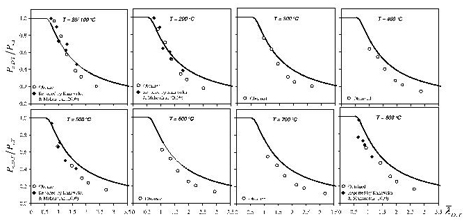
Figure 3: Comparison between the modified DSM predictions and the ultimate load values obtained in this work and reported by Ranawaka & Mahendran (2009) for T = 20/100–200–300–400–500–600–700–800 °C
The ultimate goal of this investigation is the development of new DSM design curves to predict the distortional failure of simply supported or fixed lipped channel and rack-section columns subjected to elevated temperatures, namely those due to fire conditions- the available results seem to indicate that such curves should be mildly dependent on the temperature. However, a fairly large amount of research work is still required before this goal can be satisfactorily achieved.