
| doi:10.3850/978-981-08-6218-3_SS-Fr011 |
 Final Paper PDF Final Paper PDF
|
FATIGUE BEHAVIOUR OF CFRP STRENGTHENED STEEL MEMBERS UNDER PURE BENDING
H. Jiao
School of Engineering, University of Tasmania, Hobart, Australia.
hjiao@utas.edu.au
EXTENDED ABSTRACT
This paper investigates the fatigue behaviour of two types CFRP materials under 4-point bending. Sika® CarboDur M1214 laminated plates and SikaWrap® Hex-230C carbon fibre fabric were used in retrofitting cracked beams. The aim of this study is to compare the fatigue performance of the flexible CFRP fabric with CFRP plates, and explore the feasibility of applying CFRP fabrics on curved structural surfaces.®
1. INTRODUCTION
The majority of trucks in mining operations are at various stages of service life. Many are experiencing fatigue cracking at various locations after a relatively short duration of service due to rough road conditions on mine sites. The cracks were generally repaired by welding in accordance with international welding standards [1, 2]. However, cracking recurs in a short period after repair due to stress concentrations around the weld, causing significant loss in repair costs and interruption to truck operations.
In this paper, two types of CFRP materials, Sika® CarboDur M1214 laminate and SikaWrap® Hex-230C carbon fibre fabric were used in retrofitting cracked beams. The aim of this study is to test the effectiveness of CFRP and epoxy strengthening system in controlling crack development and extending the fatigue life of metallic structures
2. MATERIAL PROPERTIES
The steel beams used in the tests were 150UB14. The yield stress and ultimate strength were 362MPa and 524MPa respectively, which were obtained through tensile coupon test. The test sample was cut from the web of a beam.
Two types of CFRP materials were used, which were Sika® CarboDur M1214 laminate plates and SikaWrap® Hex-230C carbon fibre fabric.
Araldite 420 was used in the bonding of all beams. It is a high strength epoxy adhesive that was used in strengthening welded connections of very high strength steel [5].
3. SPECIMEN PREPARATION AND TEST SETUP
A 4-point bending rig was constructed so that the fatigue tests could be conducted using a MTS-810 testing machine which had a loading capacity of 100kN. The test setup is shown in Figure 1.
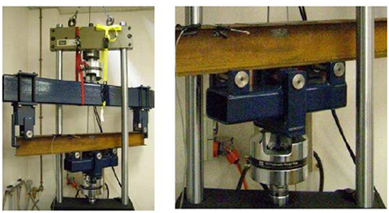
Figure 1: Setup of the 4-point bending fatigue test
All fatigue tests were performed under load control mode. A load range of 12kN to 35kN was applied with a loading frequency of 7Hz.
4. TEST RESULT
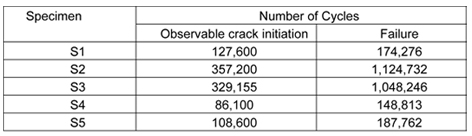
Table 1: Number of cycles for crack initiation and failure
5. CONCLUSIONS
CarboDur M1214 plate and Araldite 420 epoxy system showed significant fatigue behaviour than SikaWrap® Hex-230C fibre fabric. The fatigue life of beams retrofitted with CarboDur M1214 plate was about three times of the beam repaired with welding method.