
| doi:10.3850/978-981-08-6218-3_SS-Fr006 |
 Final Paper PDF Final Paper PDF
|
FULL STRESS ANALYSIS OF STEEL STORAGE INDUSTRIAL EQUIPMENTS UNDER SEISMIC LOADING
A. Di Carluccio1,a, G. Fabbrocino1,b and G. Manfredi2
1Structural and Geotechnical Dynamics Lab, Department SAVA, University of Molise, Termoli (Cb), Italy.
aantonio.dicarluccio@unimol.it
bgiovanni.fabbrocino@unimol.it
2University of Naples Federico II, Department of Structural Engineering, Napoli, Italy.
gamanfre@unina.it
EXTENDED ABSTRACT
Recent worldwide natural disasters have focused the public attention on the damages which may derive from the interaction among industrial installation and natural catastrophic events. The seismic event is certainly one of the most critical external event to the safety of industrial plants. Seismic behaviour of industrial equipment is relevant in the framework of industrial risk assessment because collapse of these structures may trigger other catastrophic phenomena due to loss containment. Review of typical industrial layouts shows that a large number of components and systems are strongly standardized. This is a relevant aspect in the framework of seismic protection of existing plants, since simulated structural design is sometimes needed starting from poor data. Among industrial components, atmospheric steel tanks for oil and other hazardous material storage are commonly used in power plants, airports, and other critical plants. Furthermore, their design is very standardized world-wide and thus they represent a challenging topic in the contexts of an industrial risk assessment related to external hazards like earthquakes. In fact, their dynamic response is not trivial, since fluid/structure interactions are relevant and influence the susceptibility to seismic damage. Base shear and overturning moments due to seismic actions lead to two main damage scenarios of such constructions: large displacements at the base for unanchored tanks and elephant foot buckling of the shell, primarily in the case of anchored tanks. A full stress analysis is certainly the more accurate way to design and to evaluate the risk of steel tanks under earthquake loads, but is generally demanding in terms of computational effort. Presently the analysis of seismic behaviour of storage steel tank is possible with two different approaches: the first based on lumped mass models and second based on the use of finite elements. In the present paper, seismic evaluation according to Eurocode 8 is discussed and results of FEM analyses for anchored storage steel tanks are compared with those obtained according to simplified design procedures. Eight different geometric configurations of atmospheric tanks with similar volume capacity have been considered, depending on the filling level Υ. For each configuration a time history analysis with LsDyna’s finite element program and a calculation with the simplified procedure have been carried out. The finite element analyses presented have been performed with LsDyna code using a Lagrangian approach. Each dynamic analysis has a total duration of 50 seconds. The first two seconds are used as dynamic relaxation while the last 38 seconds are inserts to study the free oscillations of the liquid. The study of free oscillations of the liquid after the earthquake, by studying the spectrum of base shear, allows the identification of the dominant frequency of that signal. Figure 1 shows an example of the base shear normalized spectrum (Υ=1.0). The analysis of this spectrum underline that the seismic response of tank-liquid system is characterized by two dominant frequencies. These frequency values were compared with those offered by the simplified model proposed by EC8 (Figure 2). Comparison between Eurocode 8 simplified procedure and the full stress LsDyna FEM analysis are made also in terms of base shear, overturning moment and sloshing height. In particular Figures 3a, and Figures 3b show the base shear and overturning moment time history for the configurations characterized by filling level equal to 0.5. It is possible to observe that direct evaluation of the seismic behaviour of tank according to EC8 seems to be in good agreement with time histories FEM analyses. It is clearly shown that despite the large scatter in terms of computational effort, lumped mass models and LsDyna FEM results are not so different in terms of seismic demand evaluation.
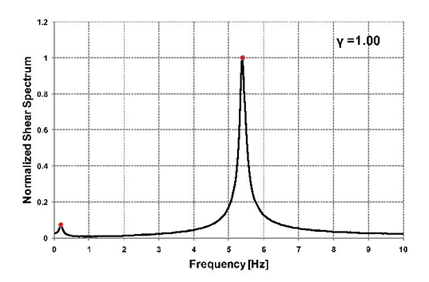
Figure 1: Base shear normalized spectrum Υ=1.0
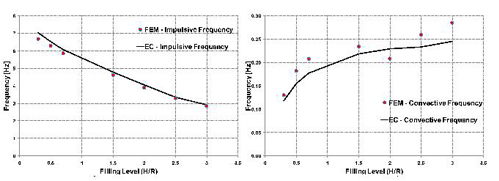
Figure 2: Comparison between FEM and Eurocode impulsive and convective frequency.
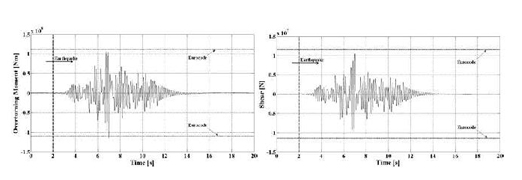
Figure 5: Comparison of results (for felling level equal to 0.3) between FEM analysis and EC model: (a) Base shear; (b) Overturning moment.