
| doi:10.3850/978-981-08-6218-3_SS-Fr005 |
 Final Paper PDF Final Paper PDF
|
RESIDUAL STRESSES IN WELDED BOX SECTIONS
A. Outtier, H. De Backera, B. De Pauw, D. Stael and PH. Van Bogaert
Bridge Research Group, Department of Civil Engineering, Universiteit Gent, Gent, Belgium.
aHans.DeBacker@UGent.be
EXTENDED ABSTRACT
Residual stresses can have an important influence on the corrosion, brittle fracture and buckling strength of steel sections. These residual stresses originate in the production process and especially during the welding of box sections. This research paper focuses on the residual weld stresses in box sections, often used for the design of arch bridges. It is part of a more general research concerning all parameters influencing the out-of-plane buckling behaviour of steel tied-arch bridges. The welding of the four plates of the box section, will lead to a non-uniform heating and cooing of the cross-section, which can result in a non-uniform distribution of the residual stresses.
As a first step, a full thermal finite element analysis is performed on the entire weld operation. This analysis models the weld torch as a time-dependent thermal flux which has the shape of a double ellipsoid in accordance with Goldak’s theorem. Because of the high temperatures during welding, all material characteristics, such as conductivity, specific heat capacity, emissivity, etc. are assumed to be temperature dependent. The actual welding is modelled using dummy elements which become active once a definite weld temperature is reached. Afterwards, temperatures at both sides of the dummy elements are equal at all times and the distance between both ends is frozen for the remainder of the finite element calculation.
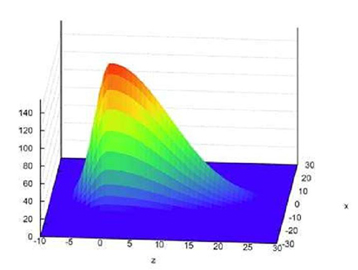
Figure 1: Heat flux input according to Goldak’s theorem
The second part of the research consists of a mechanical analysis in which the previously derived temperature distribution is used as a thermal load, resulting in the determination of the residual weld stresses. During this second part, all mechanical boundary conditions are varied identical to the actual handling of the box section during the welding, using several clamps, struts, etc. These boundary conditions restrict the expansion of the steel during the heating and differential cooling of the material.
The overall conclusion of both calculation steps is that important residual tensile stresses will arise close to all welds, while small compressive stresses occur in the rest of the cross-section. Furthermore, it seams that the heat-influenced region will be considerably bigger, if multiple weld steps are used, thus resulting in a larger area with important residual stresses. In addition, the distribution of the weld stresses over the cross-section is found to be slightly asymmetrical due to the asymmetrical order in which all weld passes are executed and the asymmetry of the boundary conditions during welding.
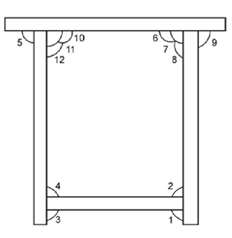
Figure 2: Box section, welded in 12 weld passes
Nevertheless, a more generalised symmetrical residual stress distribution can be proposed, which can be used for further calculation. However, distinction has to be made between slender (height to width ratio of about 40) and more robust cross-sections (height to width ratio of 15 and lower). The area with high residual stresses will be comparable for both types of box sections. However, the area over which the high tensile stresses decrease is much more important for robust cross-sections. This will also result in the compressive stresses, halfway between welds, to be slightly higher.
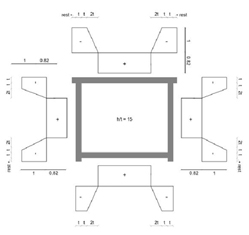
Figure 3: Simplified distribution of residual weld stress in a more robust welded box section.
In a final part of this research project, the influence of this residual weld stress distribution on the buckling behaviour of arch bridges is studied using non linear-elastic buckling calculations of highly detailed finite element models of recently built arch bridges. The overall conclusion has to be that a certain influence exists, but that it is quite small due to size of the considered cross-sections. In addition, the influence of the residual stresses on the buckling behaviour is found to be diminishing as the normal force of the arch near the critical buckling load.