
| doi:10.3850/978-981-08-6218-3_SHM-We042 |
 Final Paper PDF Final Paper PDF
|
DETECTION OF DELAMINATION IN RC STRUCTURES USING WAVELET PACKET ANALYSIS
G. Ou1, X. Zhu2, Y. Wang1 and H. Hao1
1School of Civil and Resource Engineering, the University of Western Australia, Perth, WA
2School of Engineering, University of Western Sydney, Sydney, NSW.
xinqun.zhu@uws.edu.au
EXTENDED ABSTRACT
This paper presents a novel technique to detect the delamination between steel bars and concrete in RC structures using wavelet packet analysis. A damage index is constructed based on the wavelet packet component energy change. The experimental study is carried out on a concrete slab with different debonding damages between steel bars and concrete. The piezoelectric components are mounted on steel bars that are embedded in the slab as actuators and sensors. The results show that the wavelet packet component energy is sensitive to the debonding damage and could be a good damage indicator.
1. THEORETICAL BACKGROUND
According to the definition of wavelet packet component energy, the damage index can be defined as the degree of difference between responses of damaged structure and those of healthy ones. The wavelet packet component energy Eixhj of the healthy structure can be calculated from the measured signals on the intake structure or from numerically simulated wave propagation signals on structure without damage. Similarly the wavelet component energy Eixj of the damage structure can be calculated from the measured signals on structures at its current condition. The damage index is defined as:

2. EXPERIMENTAL RESULTS AND ANALYSIS
About 40 tests were executed in every different frequency condition, which were 200 tests in total. DB4 from Daubechies wavelet family was adopted for wavelet packet analysis. The level of WPD was set at 7 and a total of 128 wavelet packet components were obtained. The Sampling rate was set to 2 million Hz then the frequency band width for one component can be generated according to the number of wavelet components. Figure 1 shows the wave propagation along the rebars with different debonding lengths when the excitation frequency 4th International Conference on Steel & Composite Structures Wednesday 21 – Friday 23 July 2010 Sydney, Australia is 50kHz. The input waves are the same, but the response signals are different for rebars with different debonding lengths, clearly indicating the influence of debonding on wave propagations.
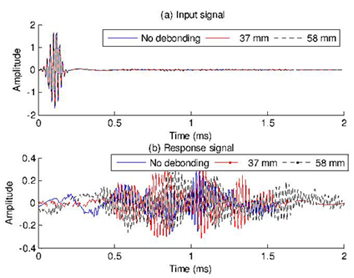
Figure 1: Wave propagation along the rebars with different debonding lengths
Figure 2 shows the relationship between the debonding length and damage index. The excitation frequency varies from 30 KHz to 50 KHz, and the number of wave cycles is 7. The results show that the damage index increases with the debonding length. With the excitation frequency 30kHz and 40kHz, the damage index has an approximate linear relationship with the debonding length, and the slope is 0.0048 and R2 = 0.9837 for 30kHz. However, it is not linear when the wave frequency is 50kHz.
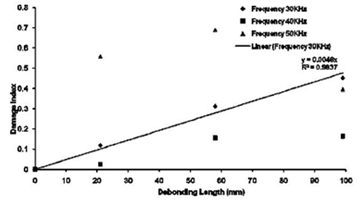
Figure 2: Relation between the damage index and the debonding length