
| doi:10.3850/978-981-08-6218-3_SHM-We030 |
 Final Paper PDF Final Paper PDF
|
PIPELINE BEDDING CONDITION ASSESSMENT USING ENERGY-BASED STRATEGY
X. L. Penga, H. Haob and Y. Wangc
School of Civil and Resource Engineering, the University of Western Australia, Perth, Australia.
apeng@civil.uwa.edu.au
bhao@civil.uwa.edu.au
cywang@civil.uwa.edu.au
EXTENDED ABSTRACT
The present study investigates the damage identification of a pipe-soil system using energybased strategy. Firstly, a numerical simulation is performed to explore the feasibility of using energy-based strategy due to ambient excitation to identify the damage on pipeline with soil underneath. Then a scaled pipe model is designed and built with a steel pipe lying on sand. Dynamic tests are carried out with seven damaged cases which are simulated by removing soil underneath the pipe. Both the energy differences and energy curvature differences are calculated to identify damage locations and severities. Numerical and experimental results show that energy strategy method with out-put only data can assess pipe bedding condition with considerable reliability.
1. ENERGY DAMAGE DETECTION STRATEGY
Without considering the input excitation, an energy index based on out-put only acceleration response under ambient excitation is used in this study.

The energy difference ΔE between the damaged and undamaged structures can be written as follows
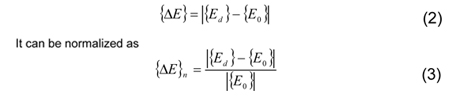
The location of the damage is then assessed by the largest energy difference between the damaged and undamaged structures. Another energy index is energy curvature difference, which can be written as

2. EXPERIMENT TESTING AND RESULTS
2.1 Experimental testing
 |
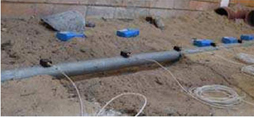 |
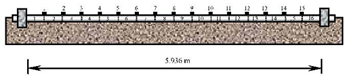
Figure 3: Scaled pipe-soil model |
Figure 4: a testing photo (DMG2) |
2.2 Damage detection results based on experimental data
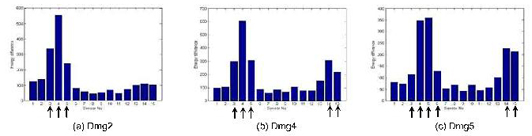
Figure 5: The absolute energy difference from experimental data
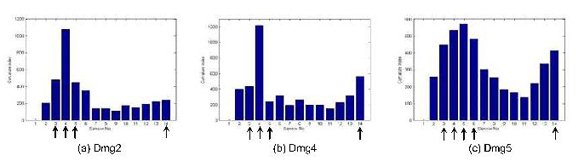
Figure 6: The energy curvature difference from experimental data
3. CONCLUSIONS
In this paper, a new application of energy-based damage identification method on a pipe-soil system is presented. The feasibility of using vibration data to monitor the free span damage under the pipeline has been studied. A scaled pile-soil model was designed and constructed and then a series of ambient vibration tests were conducted on it. Free span damage is simulated by removing soil under the pipeline with different lengths and locations. A finite element model based on this scaled model considering pipe-soil interaction has been developed. Numerical simulations and experimental studies show that both the energy difference and the energy curvature difference are effective and reliable in identifying the free span damage in the pipeline system. The damage identification of a real structure is a complicated procedure, which may be affected by a lot of factors. It is good if the results can be verified by two different methods, which will increase the reliability of identified results.