
| doi:10.3850/978-981-08-6218-3_SHM-We029 |
 Final Paper PDF Final Paper PDF
|
UNDERWATER PIPELINE CONDITION MONITORING BASED ON AMBIENT VIBRATION MEASUREMENT
X. L. Penga and H. Haob
School of Civil and Resource Engineering, the University of Western Australia, Perth, Australia.
apeng@civil.uwa.edu.au
bHao@civil.uwa.edu.au
EXTENDED ABSTRACT
This paper presents a numerical investigation of vibration-based damage detection of undersea pipeline under operational conditions. Because it is difficult to excite the subsea pipeline and measure the input signal in deep water environments in practice, the vibration based damage identification has to depend on ambient vibration tests with wave forces to excite the pipeline. In this study, JONSWAP spectrum is employed to model the wave surface elevation, from which the wave force spectrum is obtained by utilising the Response Amplitude Operators (RAO). A finite element model is developed to calculate the dynamic responses of pipelines to ambient wave forces. The model takes into consideration the interaction between ocean waves, submarine pipeline and seabed. The calculated dynamic responses are used to extract pipeline vibration properties, which in turn are used in model updating calculation to identify the pipeline conditions. Different levels of noise are assumed and smeared into the simulated wave forces to simulate uncertainties from ambient hydrodynamic environment. The effect of noise levels on identification results of the pipeline conditions is investigated.
1. WAVE FORCE SIMULATION
One of the most commonly used spectral density functions of wave surface elevations is the JONSWAP spectrum. Transferring of the wave amplitude into the responses of a structure can be achieved through a Response-Amplitude Operator, which is a normalized response function for a range of wave frequencies of interest of a given offshore structure. Then lift force time history can be simulated from its spectrum.
2. FINITE ELEMENT MODEL OF THE PIPELINE
In this study, a Finite Element model of submarine pipeline is developed using ANSYS according to the Second Trunk Line pipeline in the North West Shelf of Australia. The pipeline model built in this section is used for both dynamic response calculation and model updating.
3. DYNAMIC PROPERTIES EXTRACTION AND DAMAGE DETECTION
3.1. FRF method
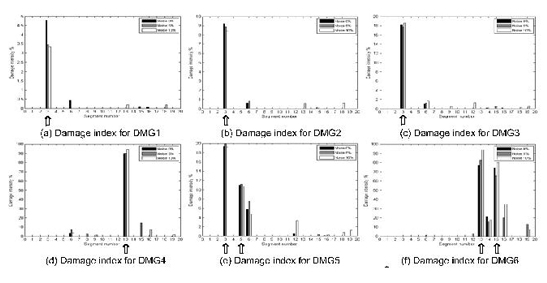
Figure 1: Damage identification results using dynamic properties extracted by FRF (⇑ indicates real damaged location)
3.2. SSI method
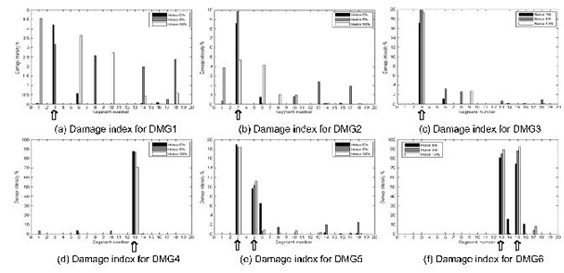
Figure 2: Damage identification results using dynamic properties extracted by SSI (⇑ indicates real damaged locations)
4. CONCLUSIONS
Numerical simulation results demonstrate that it is feasible to identify subsea pipeline conditions by performing Finite Element model updating with dynamic parameters obtained from ambient vibration tests. Damage locations and severities for all six damaged cases can be successfully identified with the dynamic parameters extracted using FRF technique both in noise free and noise contaminated situations, which indicates FRF is a reliable modal parameter extraction method if the input is known. Using SSI method with only output data, the damage can be accurately located only when the damage intensity is larger than noise level.