
| doi:10.3850/978-981-08-6218-3_FRP-Fr038 |
 Final Paper PDF Final Paper PDF
|
COMPRESSIVE PERFORMACES OF THE CONCRETE FILLED CIRCULAR CFRP-STEEL TUBES (2): THEORETICAL ANALYSIS
M. Y. Mao1,a, Q. L. Wang1,b and Y. B. Shao2
1School of Civil Engineering, Shenyang Jianzhu University, Shenyang, Liaoning.
a356396105@qq.com
bceqlwang@sjzu.edu.cn
2School of Civil Engineering, Yantai University, Yantai, Shandong.
cybshao@ytu.edu.cn
EXTENDED ABSTRACT
Analysis based on finite element method indicates that outer tube of the concrete filled circular CFRP-steel tubular stub columns under compressive load can provide effective confinement to the concrete even in initial loading period. This phenomenon is much different from that of the concrete filled circular steel tubular stub columns under compressive load. Additionally, the circumferential stress increases sharply and the longitudinal stress decreases remarkably when the maximum load bearing capacity is reached. More CFRP can improve the peak stress and the peak strain of the C-CFRP-CFST stub columns under compressive load dramatically.
1. INTRODUCTION
The confinement effect provided by CFRP for concrete filled circular steel tubular (hereinafter referred to as C-CFST) stub columns under axial compressive load are analyzed; also, the stress and strain distributions for materials are discussed respectively.
2. THEORETICAL ANALYSIS
Figure 1 shows the stress-strain (σ-ε) curves of concrete filled circular CFRP-steel tubular (hereinafter referred to as C-CFRP-CFST) stub columns under axial compression, where σcfsc is nominal compressive stress of the stub columns, σcl is compression stress of concrete, σsl is longitudinal stress of the steel tube, σcfθ is tension stress of CFRP, and p is confinement force. As shown in Figure 1, the steel tube always provides positive confinement force to the core concrete for C-CFRP-CFST stub columns due to the existence of CFRP, this phenomena is much different from that of C-CFST stub columns.
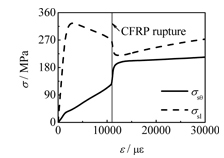
The variations of σsl and circular stress of the steel tube (σsθ) on the mid-height cross-section of C-CFRP-CFST stub columns under compression are plotted together in Figures 2. Figure 2 ignore the stress sign. It can be seen from Figure 2 that σsθ increases rapidly and σsl decreases sharply when CFRP ruptures.
 |
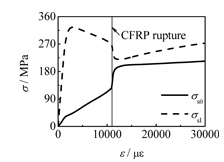 |
Figure 1: σ-ε curves of C-CFRP-CFST stub columns under axial compression |
Figure 2: Stress-strain curves of the steel tube for C-CFRP-CFST stub coulumns |
The influences of CFRP confinement factors (ξcf) and steel tube confinement factors (ξs) on longitudinal stress-strain curves for C-CFRP-CFST stub columns under axial compression are illustrated in Figures 3 (a) and 3 (b), respectively.
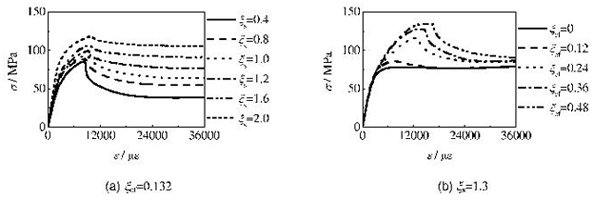
Figure 3: longitudinal stress-strain curves of C-CFRP-CFST stub columns.
As shown in Figure 3, the peak stress of concrete increases as steel tube confinement factor becomes bigger and CFRP confinement factor is kept constant. However, the variation of the peak stress value is not very remarkable. When steel tube confinement factor is kept constant and CFRP confinement factor becomes bigger, the peak stress and strain are both increase.
3. CONCLUSIONS
(1) The outer tube of concrete filled circular CFRP-steel tubular stub columns always provides confinement force to the core concrete. (2) When the CFRP is fractured, the circular stress of steel tube increases rapidly whereas the longitudinal stress decreases sharply. (3) More CFRP can improve the peak stress and the peak strain of the C-CFRP-CFST stub columns dramatically.
4. ACKNOWLEDGEMENTS
The research reported in the paper is part of the Project NCET-08-0865 supported by New Century Excellent Talent of the Ministry of Education of China, and the Project 2007R31 supported by Colleges and Universities Excellent Talent of Liaoning Province, China. Their financial supports are highly appreciated.