| doi:10.3850/978-981-08-6218-3_FRP-Fr030 |
 Final Paper PDF Final Paper PDF
|
BEHAVIOUR OF TUBULAR STEEL COLUMN — BARE, CONCRETE FILLED AND RETROFITTED
S. P. Narayanan a, V. Kalaikumar b, N. J. Cossa c, M. S. Hasifi, I. Ismail and A. Ismail
Department of Civil Engineering, Universiti Teknologi PETRONAS, Ipoh, Perak, Malaysia.
anarayanan_sambu@petronas.com.my
bkalaikumar@petronas.com.my
cnjcossa@gmail.coml
EXTENDED ABSTRACT
Steel tubular members are used in high rise buildings, industrial structures, piles, bridge piers and offshore structures. Bare sections or sections infilled with concrete are used. Tubulars damaged due to corrosion or indentation are rehabilitated by infilling with grout or concrete. The behaviour of short length steel tubular — bare or infilled with normal concrete — is widely reported. The codes provide expressions for evaluating the nominal strength of short and long, bare and infilled steel columns. Not many studies on intermediate length steel columns are reported. The research on concrete infilled steel tubular sections studied the following aspects: (1) Short Steel tubular members CHS30 and CHS50 were infilled with concrete of grade 30, 60 and 80MPa and grout and tested in axial compression. The slenderness was kept below limiting values for short columns. The experimental values were compared with ultimate strength predictions of EC4, BS5400, ACI, AS and AIJ (2) Steel tubulars of intermediate length, with slenderness in between 50 and 200, were infilled with concrete of grades 30, 60 and 80 MPa were tested in axial compression and compared with predicted ultimate strengths using EC4, BS5400, ACI, AS and AIJ. (3) Rehabilitation of “artificially damaged” tubulars using concrete and grout. The “artificial damage” simulated patch type corrosion commonly seen in offshore tubulars, and is obtained by grinding an area of the surface to a specific width, height and reduced wall thickness. The specimens were tested in axial compression. Similar damaged columns specimens were retrofitted using concrete and grout. The rehabilitated strength is compared to the original strength of the tubular for determining the effectiveness of the infill.
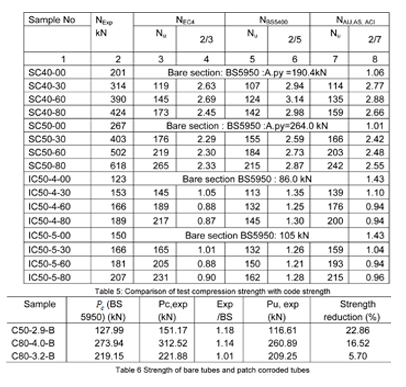
The compression strength of bare and concrete filled short columns and the intermediate length columns with and without concrete infill are given in Table 5. Table 6 shows the compression strengths of intermediate length bare tubes from experiment (col.3) and the patch corroded tubes (col.5). The strength reduction due to standard patch varies between 5.70 to 22.86%. Since the test results show adequate reduction in strength, the parameters of patch corrosion is adequate. Table 5 shows the comparison of the experimental results and the design codes. The test tests results are higher by 20–35% than those predicted by BS 5950. EC4 predicted the highest values among all codes. As the concrete strength increases, the EC4 predicts higher values than the experimental load. The EC4 over prediction is by 10%. The ACI, AS and AIJ provided values relatively closer to the experimental results. However there is a tendency of over prediction, when the concrete strength increases. For instance the NExp/NAS/ACI ratio is 0.94 for specimens with concrete grades 60MPa and 80MPa. The strength gain of patch corroded member when infilled with concrete or grout varies from 3.52 % to 64.71%, the largest gain being for the grout infilled corroded member.