
| doi:10.3850/978-981-08-6218-3_CC-We036 |
 Final Paper PDF Final Paper PDF
|
AN EXPERIMENTAL STUDY ON FULL SIZE CONTINIOUS SLABS WITH PROFILED SHEETING UP TO THE ULTIMATE CONDITION
K. Taskina and E. Yukselb
Civil Engineering Faculty, Istanbul Technical University, Istanbul, Turkey.
ataskinkiv@itu.edu.tr
byukselerc@itu.edu.tr
EXTENDED ABSTRACT
Composite slabs utilizing cold formed profiled steel decks are widely used for floor systems in construction industry. The behavior of composite slab is controlled by the horizontal shear bond between the steel deck and concrete. The design parameters can be obtained from full sized bending tests. 1/1 scale 3 spans bending tests are conducted in the laboratory. The experimental program consisted of 4 specimens with two different slab thicknesses. The vertical loads applied as equal concentrated forces for each span were increased gradually to reach the ultimate condition. The vertical load versus displacement relationships, slips and failure modes are presented and evaluated. The obtained test results are compared with that of the simple calculation procedure defined by SDI (Steel Deck Institute). The overload factors and displacement ductility of the tested specimens are evaluated with the code specified quantities.
The profiled steel sheeting composite floor has been recognized for its efficiencies in construction and its higher load carrying capacity. The shear-bond resistance is essential to the interaction between steel sheeting and concrete at the sheet-concrete interface, and governs the composite slab design.
The experimental parameter of the study is slab thickness. The thicknesses of 110 and 150 mm which are commonly used for ordinary type of structures are investigated in the study. Four full size continuous slabs with profiled sheeting were tested under gradually increasing vertical static loads. All of the tests were continued until significant slip observed.
The average compressive strength and modulus of elasticity of concrete were determined as 27.3 MPa and 30811 MPa, respectively. The average yield stress of re-bar and profiled sheeting are 546 MPa and 305 MPa, respectively. The slab details were selected to reflect the typical construction practice. The sheet thickness was chosen as 0.8 mm. The reinforcement mesh of 6 mm diameter bars at 150 mm spacing was utilized and the wire mesh is located 45 – 50 mm beneath top of the slab. The span lengths of all specimens are 1750 mm. The slab width is 1000 mm. Figure 1 illustrates the test set-up including testing frame, hydraulic jacks, load sharing beams and supports of the specimens. The specimens were subjected to gradual incremental static point loads. Various strain gauges and displacement transducers were positioned on the specimens.
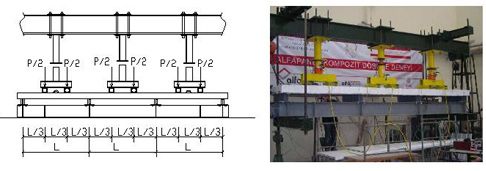
Figure 1: Test set-up
Applied load versus mid span deflection curves are given in Figure 2. The load corresponding to the first crack and yielding of profiled sheeting for the slabs with 110 mm thickness were 66 kN and 87 kN, respectively. It is noted that the load versus mid span deflection curve for second span of CS_3S_H110_S08_2 has a different character from the others. The load corresponding to the first crack and yielding of profiled sheeting for the slabs with 150 mm thickness were 64 kN and 155 kN, respectively.
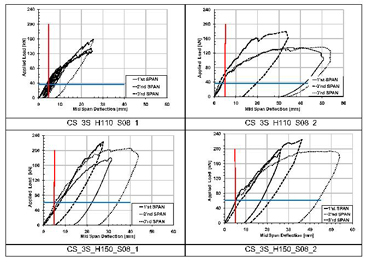
Figure 2: Load versus Mid Span Deflection Curves
The achieved test results are compared with that of the simple calculation procedure defined by SDI (Steel Deck Institute). The estimated span point load for 110 mm and 150 mm slab thicknesses are 38 kN and 60 kN and shown by blue lines in Figure 2, respectively. Consequently, the overload factors are 3.4 and 2.8, in that order. The service deflection limit (L/360) shown by red lines in Figure 2 is comparatively smaller than the ultimate displacement capacities achieved.