
| doi:10.3850/978-981-08-6218-3_CC-We035 |
 Final Paper PDF Final Paper PDF
|
BEHAVIOUR OF SEMI-RIGID FRAMES WITH CONCRETE-FILLED STEEL TUBULAR COLUMNS AND STEEL BEAMS
Z. Tao1,2,a, L. H. Han3, W. D. Wang4 and T. Z. Du1
1College of Civil Engineering, Fuzhou University, Fuzhou, Fujian Province, China
2School of Engineering, University of Western Sydney, Penrith, Australia.
az.tao@uws.edu.au
3Department of Civil Engineering, Tsinghua University, Beijing, China.
lhhan@tsinghua.edu.cn
4College of Civil Engineering, Lanzhou University of Technology, Lanzhou, China.
wangwd@lut.cn
EXTENDED ABSTRACT
This paper describes an experimental investigation of ten planar semi-rigid frames with concrete-filled steel tubular columns and steel beams, which were conducted under combined constant axial load and cyclic lateral load. The observed failure modes, hysteretic responses, and effects of different parameters on ductility and energy dissipation were discussed. The semi-rigid frames demonstrated generally good cyclic behaviour and have the potential to be used in buildings.
1. INTRODUCTION
Concrete-filled steel tubular (CFST) columns are currently being increasingly used in buildings. Conventionally, fully rigid or flexible steel beam-to-CFST column connections are very popular to be used. In view of this, a considerable amount of study has been performed on the behaviour of rigid or hinged composite connections and frames. In fact, most of the so-called pinned connections possess some rigidity, while the connections regarded as rigid often show some flexibility. An experimental investigation of ten planar semi-rigid frames with CFST columns and steel beams was performed, and the test results are discussed in this paper.
2. EXPERIMENTAL PROGRAM
All semi-rigid frame specimens were constructed using extended end-plate connections, where five of them were constituted with circular CFST columns and the others were square columns. The test frames were designed to investigate the effects of the following parameters on the behaviour: 1) Column cross-sectional shape (circular and square); 2) Level of axial load to the column, n (=0.05, 0.3 and 0.6); and 3) The beam-column linear stiffness ratio k (=0.194∼0.460).
In testing the specimens, the axial load (N0) of a column was applied and maintained constant by a hydraulic ram, and the lateral cyclic load was then applied at the end of the steel beam. The bottoms of the two columns for a specimen were fixed through a rigid foundation beam which was fixed to the floor with bolts.
3. TEST RESULTS
All frames showed a similar strong-column-weak-beam failure mode. Generally, the hinges on the columns were formed after the beam hinges. From the test observations, there is no obvious difference between the rigid and semi-rigid frames in terms of failure modes.
Typical measured lateral load (P) versus lateral displacement (Δ) curves are shown in Figure 1. The test results showed that the P-Δ hysteretic curves of the composite frames were plump shuttle shape. The semi-rigid composite frames exhibited favorable cyclic behaviour and energy dissipation capacity.
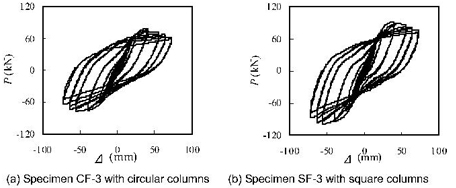
Figure 1: Typical lateral load (P) versus displacement (Δ) curves
The ultimate lateral load Pmax decreases with increasing axial load level n, and Pmax increases slightly as k increases. Dissipated energy (E) and ductility coefficient (µ) can be used to gauge the energy dissipation ability and ductility of composite frames. In general, E increases by over 10% when the axial load level n increases from 0.05 to 0.3, but E decreases to the original value when n increases from 0.3 to 0.6. With an increasing of the beam-column linear stiffness ratio k, the values of E remain the same for frames with circular columns. The trend for those with square columns is not so clear.
There is no significant influence on µ as n increases for frames with circular columns, while apparent ductility decline can be observed for specimen SF-4 with an n of 0.6. The value of µ increases with increasing k except specimen CF-2.
4. CONCLUSIONS
Semi-rigid composite frames exhibit a ductile and stable hysteretic behaviour, which is similar to that shown in rigid composite frames. But the initial stiffness and ultimate strength are lower owing to the adoption of semi-rigid connections. All the three factors, i.e. the tube shape of columns, axial load level and beam-column linear stiffness ratio, have some effect on the cyclic behaviour of semi-rigid composite columns.
5. ACKNOWLEDGEMENTS
The research reported in the paper is part of the Project 111079 supported by the Fok Ying Tong Education Foundation, and the New Century Outstanding Talents Supporting Project of Universities in Fujian Province (XSJRC2007-05). This support is gratefully acknowledged.