
| doi:10.3850/978-981-08-6218-3_CC-We022 |
 Final Paper PDF Final Paper PDF
|
EXPERIMENTAL BEHAVIOUR OF RC SHEAR WALLS FRAMED WITH STEEL REINFORCED CONCRETE (SRC) COLUMNS UNDER CYCLIC LOADING
Fei-Yu Liao1,a, Lin-Hai Han1,b and Zhong Tao2
1Department of Civil Engineering, Tsinghua University, Beijing, China.
aliaofy@tsinghua.edu.cn
blhhan@tsinghua.edu.cn
2College of Civil Engineering, Fuzhou University, Fujian Province, China.
taozhong@fzu.edu.cn
EXTENDED ABSTRACT
An experimental investigation of six shear wall models, including three RC shear walls framed with SRC columns and three counterparts framed with RC columns, was conducted under constant axial load and cyclic lateral load. The strength, ductility, stiffness and energy dissipation of tested models were experimentally investigated. It was found that the ductility and energy dissipation capacity of RC shear walls framed with SRC columns are superior to those of RC walls framed with RC columns.
Keywords: RC shear wall framed with SRC columns, Cyclic loading, Strength, Ductility.
This paper focuses on the seismic behaviour of composite shear walls which are RC shear walls framed with steel reinforced concrete (SRC) columns. Six shear wall models, including three RC shear walls framed with SRC columns and three framed with RC columns, were tested under a constant axial load and a cyclically increasing shear load. The specimens were designed to investigate the effects of changing the following parameters: (1) the type of boundary column (SRC or RC column); (2) the height-width ratio of RC wall, h/b (=0.62 and 0.95), in which h and b are respectively the height and the length of the RC wall; (3) the axial load level of boundary column, n (=0.26 and 0.52), which is defined as n = N0/Nu, where N0 is the axial load applied in the column and Nu is the axial compressive capacity of the column. For comparison purposes, the height, thickness and reinforcement ratio of all RC walls were kept the same. The SRC and RC boundary columns were designed as having an approximately same flexural strength.
All the specimens showed a shear-dominant failure mode. The damage process started with concrete diagonal cracking in the RC walls, and then some flexure cracks occurred at the lower portions of boundary columns. Hereafter with crack development in concrete and yielding of wall reinforcements, two inter-crossing main diagonal cracks were observed to extend approximately along the diagonal directions of the RC wall. Meanwhile, boundary columns also showed a main diagonal crack near the regions of beam-to-column connections. When the diagonal cracks of both wall and column interconnected, the specimens attained their ultimate strengths. After that, more diagonal cracks developed on the shear wall, accompanying by concrete crushing in the RC wall, spalling of concrete in the boundary columns and beam until the test ended.
The recorded curves of lateral load (P) versus lateral displacement (Δ) at the top of the specimens for all tested models are shown in Figure 1.The hysteretic curves showed evident shearing characteristic, which had a high degree pinching in the middle. The higher axial load level or lower height-width ratio, the more obvious the pinching effect for the hysteretic hoops within the limitation of the tests. There is no significant difference on the shape of hysteretic curves between RC shear walls framed with SRC columns or framed with RC columns, due to the fact that the failure mechanisms of these two types of shear wall structures are very close.
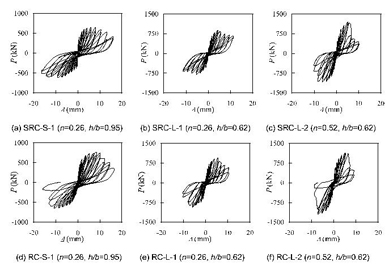
Figure 1: Lateral load (P) versus lateral deflection (Δ) hysteretic curves
The ultimate lateral load (Pu) increased with the increase of n or the decrease of h/b for the composite shear walls. Pu of a RC wall framed with SRC columns is slightly lower than that of a shear wall framed with RC columns. However, the descending stage of the P-Δ envelope curve of the specimen with SRC columns is less steep than that of the specimen with RC columns, indicating that the ductility of the former is improved over the latter.
The axial load level and height-width ratio had little effect on the relative rigidity degradation prior to ultimate strength (Pu). However, after that, the specimens showed more severe rigidity degradation with higher axial load level or lower height-width ratio. The composite shear wall shows slightly more sluggish rigidity degradation than the framed RC wall after Pu.
The ductility coefficient µ and the total dissipated energy (Etotal) decreased with the increasing axial load level or decreasing height-width ratio for the composite shear walls. And it was found that the ductility and energy dissipation capacity of a RC shear wall framed with SRC columns are superior to those of a RC wall framed with RC columns.