
| doi:10.3850/978-981-08-6218-3_CC-We021 |
 Final Paper PDF Final Paper PDF
|
FINITE ELEMENT ANALYSIS OF HYSTERETIC BEHAVIOUR OF GANGUE CONCRETE-FILLED STEEL TUBULAR BEAM-COLUMNS
G. C. Lia and Z. Shub
Dept. of Civil Engineering, Shenyang Jianzhu University, Shenyang China.
aliguochang0604@sina.com
blakewow@gmail.com
EXTENDED ABSTRACT
The nonlinear finite element program is conducted to investigate the hysteretic behavior of gangue concrete-filled steel tubular beam-columns. Proper materiel constitutive models are proposed and the results of the numerical simulation are presented and verified against the experimental data. Generally, the numerical results show very good agreement with the experimental data. And the curves are full spindle-shaped without obvious stiffness-degrading or pinch effect, showing a good dissipation energy performance and hysteresis behavior. The primary parameters considered to influence the hysteresis behavior are analyzed, including axial compression ratio, steel ratio and strength of the materials. The results demonstrate the fact that the horizontal ultimate strength and the stiffness in hardening phase decrease with an increase of axial compression ratio. Increasing the steel ratio can significantly enhance the ultimate strength and the flexural rigidity of the gangue concrete-filled steel tubular beam-columns.
Key words: Steel tube; Gangue concrete; Hysteretic curve; Ductility
1. INTRODUCTION
The nonlinear finite element program Abaqus is conducted to perform numerical simulations of GCFT beam-columns subjected to cyclic loads. 8 circular gangue concrete steel tube beam-columns are studied, and the influence of different parameters on the hysteresis curves are analyzed, including axial compression ratio, steel ratio, steel yield strength and compressive strength of gangue concrete.
2. FINITE ELEMENT MODEL
Owing to the symmetry of the specimen and boundary conditions, only one quarter of the specimen with symmetric boundary conditions on the symmetric planes was simulated.
The failure mode of GCFT beam-columns subjected to cyclic loading can be described that when the horizontal load exceeds the yield strength, buckling take place at both ends of rigid fixture in the middle of the specimen and the buckling develop laterally in the radial direction until the specimen destructed completely.
3. NUMERICAL ANALYSIS
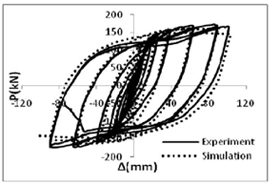
The partial results of numerical simulations for load-displacement (P-Δ) hysteresis curve of the GCFT beam-columns are plotted against the experimental data in Figure 1-2. Generally, the numerical results show very good agreement with the experimental data. It can be observed that all the hysteresis curves are full spindle-shaped without obvious stiffness-degrading phenomenon, showing a good energy absorption capacity and high ductility. Table 1 summarizes the dimensions and material properties of the specimens.

Table 1: Geometry and Material Properties of Specimens
 |
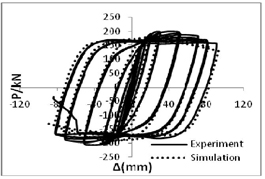 |
Figure 1: BC5-01 |
Figure 2: BC6-04 |
4. INFLUENCE OF PARAMETERS
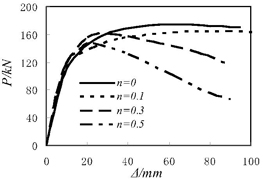
Figure 3 show the influence of axial compression ratio n on the hysteresis behaviour of GCFT. The curves of specimens (n=0, n=0.1) closely approach an elastic–perfectly plastic behaviour, specimens (n=0.3, n=0.5) exhibit a displacement-softening behaviour. And the strength degrading rate after the peak load increases with the axial compression ratio.
 |
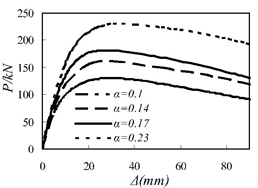 |
Figure 3: Influence of axial compression ratio |
Figure 4: Influence of steel ratio |
The influence of steel ratio α on hysteresis behaviour is shown in Figure 4, we can observe that both of the horizontal ultimate strength and the cross-sectional flexural rigidity significantly increase with steel ratio. However, the shapes of the skeleton curves can hardly change during the descent of strength.