
| doi:10.3850/978-981-08-6218-3_CC-We015 |
 Final Paper PDF Final Paper PDF
|
IN SITU TESTS ON STEEL DECK CONCRETE COMPOSITE SLABS AT ZURICH AIRPORT
M. Klippela, M. Knoblochb and M. Fontanac
ETH Zürich, Institute of Structural Engineering, 8093 Zurich, Switzerland.
aklippel@ibk.baug.ethz.ch
bknobloch@ibk.baug.ethz.ch
cfontana@ibk.baug.ethz.ch
1. INTRODUCTION
Dock B at Zurich Airport was built in 1974. After 35 years in service it will be converted to implement the Schengen agreement with the European Union. As a precondition to reuse the existing structure it had to be shown that the structure still meets the safety and serviceability requirements in particular the longitudinal shear capacity of the composite slabs after 35 years in service. Thereto large scale tests were performed in situ on the composite slabs. The test results on simple beams were analysed with the m-k-method and the partial shear connection method according to Eurocode 4, which were developed based on numerous tests under laboratory conditions.
2. EXPERIMENTAL PROGRAM
2.1. Test specimens
The two-storey building of Dock B at Zurich airport consists of a steel frame structure with stub-girders, hot rolled IPE secondary beams, HEM column sections and a composite floor slab with profiled steel sheeting (Holorib 51). The composite slabs are made of trapezoidal steel sheets with a height of the dovetail rib of 51 mm and a total concrete thickness of 120 mm. In addition a non structural pavement of 120 mm thickness is added to the slab steel frame. In order to investigate the longitudinal shear capacity of the composite slabs, after the removal of the pavement ten full-scale tests were performed on simple beams with different shear span lengths.
2.2. Test setup
As preparation of the tests (including one pre-test), strips were diamond cut from the slab but left in situ for testing as simple beams supported on the secondary beams. A testing frame was placed on the slab and fixed to the secondary beams by high strength steel rods. The testing frame is shown in Figure 1. The entire testing program had to be carried out within two weeks to avoid any interference with the ongoing reconstruction process.
2.3. Test procedure
The ten full-scale tests (included one pre-test) were carried out on simple beams with different shear span lengths to evaluate the longitudinal shear capacity of the existing deck system. The rules for laboratory tests given in Eurocode 4 were followed as close as possible. The tests were carried out on representative slabs with different shear span lengths Ls. The tests were performed with shear span lengths of approximately Ls = L/2, L/3, L/4 and L/8. The simple beams had a length L of 2.58 m. Figure 1 shows the frame for a test with Ls = L/2 (left side) and Ls = L/4 (right side).
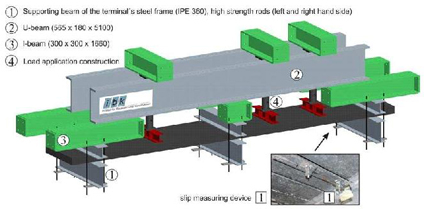
Figure 1: Testing device and bottom view of the slap with slip measurement
2.4. Test results
Besides the deflection in the middle of the beam, the relative slip between the profiled steel sheeting and the concrete was measured in all tests at a distance of about 400 mm from each support (Figure 1, bottom right). For different shear span length the maximum reached load F per jack and the corresponding deflection w is summarized in table 1.
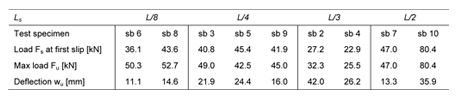
Table 1: Test results for different shear span length (load F per jack)
3. CONCLUSION
The behaviour of a steel deck composite slab with profiled steel sheeting after 35 years in service was experimentally investigated by large scale in situ tests. In all tests, the slabs showed longitudinal shear failure (bond between profiled steel sheeting and concrete). No vertical shear failure was noticed even for the tests with short shear span length of about three times the height of the slab.
The tests were assessed by the m-k and the partial shear connection method for composite slabs. It was found that the shear resistance obtained by the partial shear connection theory was slightly higher compared to the value obtained by the m-k-method.
The results show that the profiled steel sheeting after 35 years in use still features good longitudinal shear strength and is fit for reuse as slab of Dock B of Zurich airport.