
| doi:10.3850/978-981-08-6218-3_CC-We007 |
 Final Paper PDF Final Paper PDF
|
BEHAVIOUR AND MODELLING OF TUBULAR STEEL COLUMN-TO-FLAT SLAB ASSEMBLAGES
M. A. Edera, R. L. Vollumb and A. Y. Elghazoulic
Dept. of Civil and Environmental Engineering, Imperial College London, UK.
am.eder07@imperial.ac.uk
br.vollum@imperial.ac.uk
ca.elghazouli@imperial.ac.uk
EXTENDED ABSTRACT
The use of tubular steel columns in conjunction with reinforced concrete flat slabs has several advantages in terms of structural integrity and efficiency. Nonetheless, consideration needs to be given to possible connection configurations that can provide reliable performance under various loading conditions. This paper deals with the punching shear behaviour of cruciform-type shear heads in reinforced concrete flat slabs connected to internal tubular steel columns.
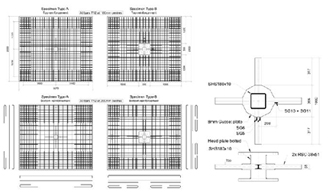
Figure 1: Reinforcement for Type-A and Type-B specimen and shear head detail
The shear head connects a reinforced concrete flat slab with the column and serves the purpose of punching shear reinforcement. Various types of shear heads can be classified in two systems: 1) Fully integrated shear heads which are entirely cast in the slab, and concrete fracture defines the ultimate capacity (recent research focused on increasing the capacity by mobilising strut and tie-action by means of shear studs and anchor plates - typically those systems have a high capacity but relatively low ductility); 2) Partially integrated shear heads connect the column with the slab via isolated structural steel members which act as a fuse (i.e. yielding of these fuses governs the performance, and the ultimate yield capacity is designed to be lower than the concrete capacity while concrete failure is strictly prevented). This paper focuses on the difference between the conventional and novel details.
Two different specimen details were tested, as indicated in Figure 1: the first slab (Type-A) reflected a conventional configuration, whereas the second (Type-B) incorporated a proposed novel connection detail, offering enhanced ductility in comparison with traditional forms.
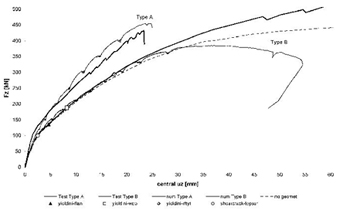
Figure 2: Load displacement plots for Type-A and Type-B specimens
Nonlinear finite element analysis was employed in order to study the complex composite punching shear under gravity loading. The finite element models were then validated against the results of two large scale tests performed in the Structures Laboratories at Imperial College London. Both the experimental and the numerical results (see Figure 2) demonstrated the comparatively favourable performance that can be obtained through the proposed novel connection detail, particularly in terms of ductility and failure mode control. In order to mobilise this ductile behaviour, careful attention needs to be given to the prevention of local deterioration in concrete in critical areas. The paper concludes with an outline of the implications of the main findings on the design approaches for this type of structural system.