
| doi:10.3850/978-981-08-6218-3_CC-We004 |
 Final Paper PDF Final Paper PDF
|
PUNCHING SHEAR RESISTANCE OF COMPOSITE SLABS WITH PROFILED STEEL SHEETING: EXPERIMENTAL TESTS AND NUMERICAL SIMULATION
L. Calado
Department of Civil Engineering and Architecture, Instituto Superior Técnico, Lisboa, Portugal.
calado@civil.ist.utl.pt
EXTENDED ABSTRACT
Composite slabs with profiled steel sheeting may in some cases be subjected to heavy concentrated loads, such as in car parks, warehouses and storage buildings. In these cases the slab can fail by punching i.e. vertical shear on the perimeter of the concentrated load. This type of failure mode is complex and depends on several parameters, namely, size of the loaded area, position of the concentrated load on the slab, reinforcing mesh presented above the sheeting, contribution from the concrete ribs and the sheeting and resistance of composite slab to longitudinal shear. The paper presents an experimental and numerical research on the punching shear resistance of composite slabs with profiled steel sheeting where some of these parameters are analyzed.
1. TESTING PROGRAM AND TEST RESULTS
Experimental tests perforned include material characterization, pull-out tests to assess the ultimate shear stress at the interface steel-concrete, and full-scale tests of continuous composite slabs with three equal spans. The parameters analyzed were the size of the loaded area and the position of the concentrated load. Three sizes of the loaded were investigated: 100x100 mm2, 200x200 mm2 and 300x300 mm2. For the concentrated load three positions were considered: central position, near the edge and near the support. The test loading procedure followed the recommendations of European Code 4. Figure 1 shows a typical force-displacement diagram and some of the failure modes observed.
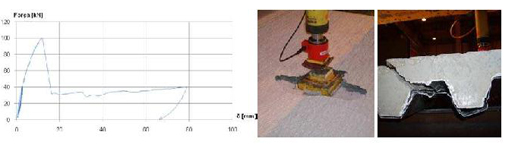
Figure 1: Typical force – displacement diagram and some failure modes.
Results of full-scale tests of continuous composite slabs indicated that for external spans the punching shear resistance seems to be independent of the size of the loaded area. This is due to the fact that for external spans the resistance of the slab is limited by longitudinal shear resistance due to the shear span and not by the punching shear resistance.
2. NUMERICAL MODELS AND VALIDATION
In this study, a 3D nonlinear finite element model was developed using ADINA® program. The model was developed with the scope of helping to understand the punching shear failure mechanism, showing namely the strain distribution and its level during the loading procedure.
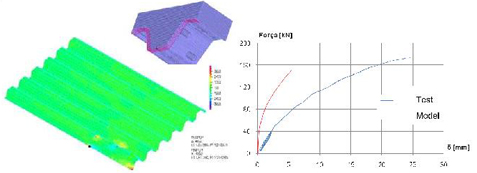
Figure 2: Stress distribution in the profiled steel sheeting and force – displacement diagram.
Analytical results showed that the developed model can be used in the verification of composite slabs for the ultimate limit states because the maximum concentrated load is obtained with a good accuracy. For the verification of the serviceability states the model is stiffer when compared with the real slab and in this sense the deflection is smaller.
European Code 4 was also used to assess the internal resistance for the relevant failure mode. Internal resistances obtained with this code agree with experimental results and give conservative results for each type of failure mode.
3. GENERAL CONCLUSIONS
The following general conclusion can be drawn from this research: in the case of external spans the punching shear resistance seems to be more dependent on the position of the concentrated load then on the size of the loaded area. This is due because the longitudinal resistance is limited by the shear span which is independent of the size of the loaded area. It depends basically of the distance between the applied load and the nearest support.
4. ACKNOWLEDGEMENTS
The author would like to thank FCT – Fundação para a Ciência e a Tecnologia, the central Portuguese governmental institution that had financed this research project.