
| doi:10.3850/978-981-08-6218-3_CC-Th038 |
 Final Paper PDF Final Paper PDF
|
BEHAVIOUR OF COMPOSITE BEAMS UNDER COMBINED BENDING AND TENSION
B. Kirklanda and B. Uyb
School of Engineering, University of Western Sydney, Sydney NSW.
ab.kirkland@uws.edu.au
bb.uy@uws.edu.au
EXTENDED ABSTRACT
The results of an experimental programme on composite beams under combined bending and tension are presented in this paper. Results from this study extend previous work to form a completed interaction diagram for composite beams subjected to combined bending and tension. The experimental series detailed in this paper, was conducted on six beams under combined positive bending and tension. The results compared well with the results from a rigid plastic analysis.
1. INTRODUCTION
Under certain loading conditions, composite beams may be subject to any combination of bending, shear and axial force. However modern steel and composite construction codes currently do not address the effects of these combined actions in a unified fashion [1][2]. Many analytical and experimental investigations have been undertaken studying prestressed composite beams or composite columns under positive and/or negative bending. Uy and Tuem [3] were the first to address the effect of tension on composite beams. Their study performed a rigid plastic analysis and cross-sectional analysis to look the ultimate strength of a section under combined bending and tension and until recently, this combined loading case had remained untested. Kirkland and Uy [4] performed an experimental series on composite beams under combined negative bending and tension.
2. EXPERIMENTAL SERIES
Six composite beams subjected to varying levels of tension and positive bending were tested. The fabrication of the specimen and test setup are the same as that described in Kirkland and Uy [4] with the beam now situated so the vertical load will induce a positive moment. The axial load was applied to the beam using load applicators connected via pins at the centre of the steel web. An initial estimate of the ultimate loadings was done through a rigid plastic analysis (RPA) of the section. Using these approximate values, the vertical and horizontal loadings were increased proportionally at approximately 10% of the calculated ultimate values until failure to complete an interaction diagram. Results from the test series and the theoretical values from the RPA are shown in Figure 1.
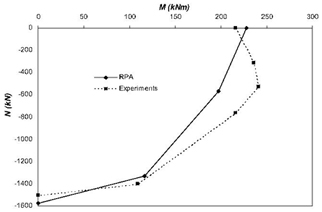
Figure 1: RPA and test results
3. CONCLUSIONS
The conservative calculations of the RPA can be seen whilst the shape of the curve still shows a good relationship. The higher test values of the cases under combined loadings can be accounted for by some strain hardening of the materials since the RPA bases its calculations on only the yield stress of the materials. Failure of the test specimen occurred through the strength of the shear connection, the tensile weakness of the concrete, concrete crushing under the applied vertical load or lateral buckling of the steel section. The degree in which each beam was subjected to the tension loading clearly determines the failure mode of the section. It is noted that small to medium amounts of tension, relative to the ultimate tensile strength of the section, can allow the beam to achieve higher moments and curvatures than the simply supported case and will produce very ductile failures. In each of the combined tests subjected to small-medium tension loads, the beams continued to hold a load close to the ultimate loading long after the actual ultimate. It was also noted that in the test on CB5, an axial force greater than that reached in the pure axial load test, CB6, was recorded. The compressive strains in the concrete caused by a positive moment allow some of the concrete to contribute to the strength of the section allowing further load.