
| doi:10.3850/978-981-08-6218-3_CC-Th031 |
 Final Paper PDF Final Paper PDF
|
NONLINEAR ANALYSIS OF COMPOSITE BEAMS WITH PARTIAL INTERACTION INCLUDING THE COMBINED EFFECTS OF BENDING AND SHEAR
A. Zona1 and G. Ranzi2
1University of Camerino, Ascoli Piceno, Italy.
alessandro.zona@unicam.it
2The University of Sydney, Sydney, Australia.
gianluca.ranzi@sydney.edu.au
EXTENDED ABSTRACT
Three different beam models for the nonlinear analysis of composite members with partial interaction are compared in this study. The considered models are obtained by coupling with a deformable shear connection two Euler-Bernoulli beams (only flexural deformability and flexural failure mode of each beam component), an Euler-Bernoulli beam to a Timoshenko beam (addition of the shear deformability and shear failure mode for one component only), two Timoshenko beams (addition of the shear deformability and shear failure mode for both components). Composite beams for which experimental results are available in the literature are used as benchmark problems to validate the numerical results. Aspects of the composite behaviour evaluated include (i) the effects of the shear deformability of the steel and slab components at various load levels; (ii) the differences in computed collapse loads obtained with the three beam models.
EXTENDED ABSTRACT
Studies on composite beam behaviour highlighted that the relative displacement between the steel beam and the reinforced concrete slab (partial interaction) due to the deformability of the interface shear connection requires to be included in the analysis for an adequate representation of the composite response. The shear connection can also be responsible for collapse, thus proper failure models for the shear connection are essential in nonlinear analysis. The first model for composite beams with partial interaction was introduced by Newmark et al. more than five decades ago. The Newmark model couples two Euler- Bernoulli beams, i.e. one for the reinforced concrete slab and one for the steel beam, by means of a deformable shear connection distributed along their interface. This shear connection enables longitudinal relative movement to occur between the two components while preventing their vertical separation. Such model has been widely applied and various formulations were presented for linear and nonlinear analysis. Modifications of the original Newmark model were recently proposed in order to include the shear deformability of one or both components of the composite beam. An analytical solution and relevant finite element formulation for linear static analysis of two Timoshenko beams coupled by means of a longitudinal interface connection (in the sequel referred to as T-T model) were presented by Schnabl et al. (2007). In their work vertical deflections were calculated for different values of parameters k (shear connection stiffness), E/G (normal elastic modulus to shear elastic modulus ratio), L/h (span-to-depth ratio) and compared to those obtained using the Newmark model. These comparisons showed that shear deformations are more important for high levels of shear connection stiffness, for short beams with small span-to-depth ratios, and for beams with high E/G ratios. A beam model including the shear deformability of the steel component only was introduced by Ranzi and Zona (2007). This model was obtained by coupling an Euler-Bernoulli beam for the reinforced concrete slab with a Timoshenko beam for the steel member by means of a longitudinal interface connection. In the sequel this model is referred to as EB-T model. Ranzi and Zona presented an extensive parametric study based on approximately 200 realistic simply supported and continuous composite bridge arrangements. Such parametric study was carried out under the assumption of linear elastic materials and considering the time-dependent behaviour of the concrete. It was found that non negligible differences between the Newmark and the EB-T models exist for realistic values of the ratio between shear stiffness and flexural stiffness of the steel beam. The effects of the shear deformations of the steel beam on the composite deformations were also observed to be more significant for higher shear connection stiffness (in accordance with Schnabl et al.) and for long-term analyses.
In this context, the objective of this paper is to evaluate the influence of the shear behaviour on the nonlinear finite element analysis results of realistic steel-concrete composite beams by comparing the Newmark (EB-EB), EB-T and T-T models. Composite beams for which experimental results are available in the literature are used as benchmark tests, i.e., a simply supported beam failing in bending (Figure 1a), and a simply supported beam failing in shear (Figure 1b). In the former case, the three beam models well predict the experimental response and their differences are small considering both stiffness and ultimate strength.
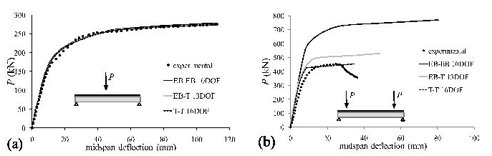
Figure 1: Load-deflection curves for (a) beam failing in bending; (b) beam failing in shear.
In the latter case, the EB-EB model gives a significant overestimation of the ultimate strength due to its inability to describe shear failure of the steel beam and/or of the reinforced concrete slab. The EB-T and T-T models give very similar results prior to the shear failure of the slab. The differences after this point are due to the fact that the EB-T model does not consider the nonlinear shear behaviour and failure of the slab. The T-T response is the one closer to the experimental results, even if the level of approximation obtained is not as good as for the beams failing in bending. However, considering the complex failure mechanism and the simplicity of the T-T beam model and relevant constitutive laws adopted, the results obtained can be indicated as satisfying. Load overestimation produced using the EB-EB and the EB-T models are 69.33% and 16.52% respectively when compared to the T-T results. Significant differences between the EB-EB and EB-T models are also observed for the deflections.