
| doi:10.3850/978-981-08-6218-3_CC-Th006 |
 Final Paper PDF Final Paper PDF
|
EXPERIMENTAL RESULTS OF STEEL-CONCRETE COMPOSITE BEAMS UNDER HOGGING MOMENT
M. Peccea, F. A. Bibbo, F. Rossi and F. Ceroni
Department of Engineering, University of Sannio, Benevento, Italy.
apecce@unisannio.it
EXTENDED ABSTRACT
This paper presents the first results of experimental tests on four composite beams tested in bending under hogging moment. The four specimens were designed varying the slab type and width and the grade of connection. During the tests the measures of deflection, strains in steel profile and bars, slips between steel section and concrete slab were recorded; the trend of all the parameters measured point out that the failure mode was influenced by global and local buckling. The evaluation of the plastic rotation and its comparison with a formulation proposed in the technical literature is reported.
1. EXPERIMENTAL TESTS
1.1. Specimens and materials
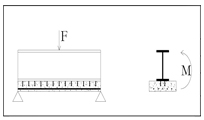
In order to have more information about the plastic rotational capacity of composite beams subjected to hogging moment, three points bending tests were carried out on four composite beams. The loading pattern with a concentrated force applied in the middle would simulate the behaviour of the beam near the beam-column joint in a frame.
In order to simplify the test procedure the composite beam has been reversed having the slab below and the steel profile above (Figure 1), obtaining the same working conditions for the materials as in the frame i.e. tensile stresses in the slab and compression in the steel profile.
 |
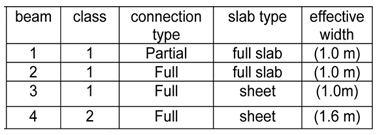 |
Figure 1: Loading pattern of the beams. |
Table 1: Characteristics of the beams tested. |
The steel profile is IPE360 with a slab thickness of 130 mm; the slab construction was made without and with profiled sheeting, in this last case two widths of the slab (1000 mm and 1600 mm) were considered.
In the design the steel type of the profile and bars were assumed respectively the S275 and B450C (NTC08); for the concrete a type C20/25 was required.
According Eurocode 4 provisions, the cross-sections of the Beams 1, 2 and 3 were designed in Class 1 and then characterized by a high rotational capacity, while that one of the Beam 4 is in Class 2 due to the greater slenderness of the web rate in compression.
In the design of the specimens a further variability was applied to the degree of connection and connectors distribution. In Table 1 the meaningful characteristics of the specimens are summarized.
Experimental tests in tension gave the following properties of steel:
| steel profile: fy=401 MPa | ft=588 MPa | εsu=17,5 % |
| reinforcing steel: fy=455 MPa | ft=577 MPa | εu=20,5% |
The compression tests on 3 concrete cubes with side of 150 mm gave a mean value of 37,6MPa.
On the specimens several measuring instruments have been placed to identify the global (load ad deflection) and local (strains in steel and bars, slip between profile and slab) behavior of the beams during the test.
1.2. Results
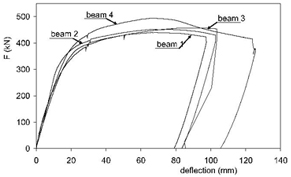
For all tested beams the same evolution of the structural behavior occurred. After the yield point, as subsequently verified by the measures, a phenomenon of local buckling in the compression region, flange and part of the web, together with a global torsion was observed. The Figure 3 reports the load-deflection curves of the four beams.
The rotation θy, corresponding to the yielding moment My theoretically evaluated, and the rotation θu, at the 85% of the maximum load (F0,85) taken on the descending branch of the load-deflection curve are identified. The difference between θy and θu provides the plastic rotation θpl.
In Table 2 the experimental plastic rotations (θpl,85% and θpl,max) of the beams tested are compared with the ones calculated (θpl,t) by the formula proposed by Chen and Jia (2008) assuming the ultimate strain of steel suggested by Kemp (1985).
 |
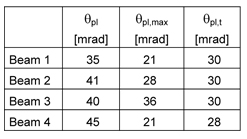 |
Figure 3: Force-deflection relationship for the four beam tested. |
Table 2: Comparison between the experimental and theoretical plastic rotation. |
2. CONCLUSIONS
The results and first theoretical comparison show that the buckling did not allow to fully develop the plastic moment and to exploit the plastic hardening of steel, resulting in a small plastic rotation, even in comparative terms with other tests available in literature. The rule proposed by Chen and Jia (2008) for evaluating the plastic rotation and limit strain at local buckling is in good agreement with experimental ones, especially if the plastic rotation is measured at the maximum load.