
| doi:10.3850/978-981-08-6218-3_CC-Th002 |
 Final Paper PDF Final Paper PDF
|
LONG TERM EXPERIMENTS ON COMPOSITE FLOOR SYSTEMS: MEMBERS WITH CONTINUOUS CONFIGURATION AND SUBJECTED TO HOGGING MOMENT WITH COMPOSITE CONNECTIONS
S. Al-Deen1,a, G. Ranzi1 and Z. Vrcelj2
1School of Civil Engineering, The University of Sydney, Sydney, Australia.
asafat.al-deen@sydney.edu.au
2School of Civil and Environmental Engineering, The University of New South Wales, Sydney, Australia
EXTENDED ABSTRACT
This paper reports two sets of experiments currently underway to determine the long-term behaviour of composite steel-concrete floor systems. This first set of experiments includes six full scale simply supported samples subjected to a sustained hogging moment. A web side plate connection is placed in the centre of the beam to reflect typical Australian detailing practice in which such a joint is adopted between a secondary beam and a primary one of a composite floor system. For this purpose, the supported solid slab is continuous over the connection. The six samples are subjected to a sustained load applied at mid-span which intends to reproduce the stress state induced in the concrete of a typical floor system when subjected to recommended sustained design actions. To gain better insight into the structural behaviour two different loading levels and two different degrees of shear connection have been considered. The second set includes the long-term testing of a full scale continuous two span composite beam. The detailing of the internal support is identical to the one adopted in the sustained hogging moment experiments. The sustained load is applied by means of concrete blocks placed along the whole member length. The long term response of these composite members is monitored by measuring the changes in deflections, curvature, strain and slip occurring over time. Standard tests are carried out on concrete, steel and shear connectors to determine the individual material properties.
The instantaneous and long-term deflections measured at mid-span of the sustained hogging moment experiments, i.e. at the location of the composite connection, are shown in figure 1. A sustained load is applied to all samples at day 36 from the concrete pour. Out of these six, four (HM01 to HM04) are designed with partial shear connection with a degree of shear connection of 0.5. The remaining two (HM05 and HM06) are designed with full shear connection. From figure 1a it can be seen that for the same degree of shear connection, specimens with higher level of cracking exhibit larger instantaneous deflections. The higher level of cracking reduces the effective cross-section, resulting in larger deflection. For the same level of cracking specimens with lower degree of shear connection have larger instantaneous deflections. Long term deflections shown in figure 1b are calculated by subtracting instantaneous deflections from the total ones. The specimens with lower level of cracking have larger long term deflections.
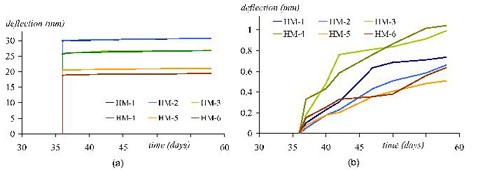
Figure 1: Deflection of the specimens at various time (a) Total deflection, (b) long term deflection
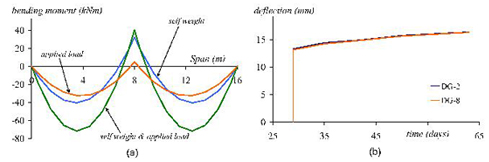
Figure 2: (a) Bending moment diagram of continuous beam at various load, (b) Total deflection at the mid span of both spans of the continuous beam at various time
In the case of the continuous beam experiment, once the props are removed, the beam deflects due to self weight. A sustained load is applied to evaluate the long-term effects of low levels of live loads appropriate for Australian flooring systems, i.e. equivalent to approx. 40% of the live load used in design. Cracking has occurred in the concrete slab near the internal support under the application of the sustained loading. Reactions of the three supports are measured by means of load cells. Based on the known applied load and the measured support reactions the bending moment diagram of the beam is plotted (Figure 2a). The concrete at the middle support cracked after the application of the superimposed load, therefore reducing the rigidity of the member in its hogging moment region. The results of the two mid span instantaneous deflections are very similar, confirming the symmetric behaviour of both spans (figure 2b). Unlike the case of the sustained hogging moment experiments, the time dependent deflections observed for the continuous configuration are considerable when compared with the instantaneous deflection, partly due to the moderate cracking occurred over the internal support and significant concrete contribution provided to the flexural rigidity along the end spans.