
| doi:10.3850/978-981-08-6218-3_CC-Fr043 |
 Final Paper PDF Final Paper PDF
|
EXPERIMENTAL BEHAVIOUR OF PRE-COMPRESSED CONCRETE-FILLED STAINLESS STEEL TUBULAR COLUMNS SUBJECTED TO TRANSVERSE IMPACT LOADS
Mohammad Yousuf, Brian Uy and Zhong Tao
School of Engineering, University of Western Sydney, Penrith South DC, NSW 1797, Australia
EXTENDED ABSTRACT
This paper presents the analysis and design of concrete filled stainless steel tubular column under impact load with pre-compressive condition. A comprehensive test program has been carried out recently at the University of Western Sydney and University of Wollongong to investigate the performance of pre-compressive stainless steel concrete filled steel tube (CFST) columns subjected to impact loading. At the same time, material tests using Split Hopkinson’s Bar apparatus were also conducted at Hunan University, China. These test results are reported in this paper, where the performance of pre-compressive stainless steel CFST columns is compared with that of mild steel CFST columns. The main objective of this paper is to compare the performance of stainless steel CFST column with mild steel CFST column. Moreover, the behaviour of in-filled tubes under impact loading with pre-compressive load is also compared with that of hollow sections. Generally, the stainless steel specimens showed improved energy-dissipating behaviour compared with mild steel counterparts, especially when concrete was used to fill the hollow tubes.
In recent times, there is an accelerating interest for engineers to provide design to withstand impact and blast loadings, particularly for critical infrastructure protection throughout the world. It has been seen that impact load is becoming an important factor in the design of many infrastructures. Impact load design is an important aspect of structural design because consideration of this greatly reduces the hazards to life and limits property loss from the structures. This is attributed to the fact that stainless steel is extremely durable, corrosion resistant, fire resistant and easily maintainable. Therefore, it is expected that the behaviour of stainless steel concrete filled steel tube (CFST) also differs from that of conventional mild steel CFST columns.
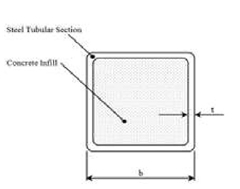
Figure 1: Typical concrete filled steel tube (CFST) section (t is steel section wall thickness)
The compressive load was applied onto two end plates through a threaded high tensile bar which was tensioned by a nut to achieve a compressive load that was 40% of the global buckling load. The following pre-compressive loads are applied based on the global buckling of each column shown in table 1.
Table 1: Pre-compressive load on specimen
In total eight no of pre-compressive specimens were tested for static and impact testing. All tests have done in both cases static and impact as a simply supported condition. The summary of static and impact test results are shown in Table 2 & Table 3 respectively.
Table 2: Summary of static test results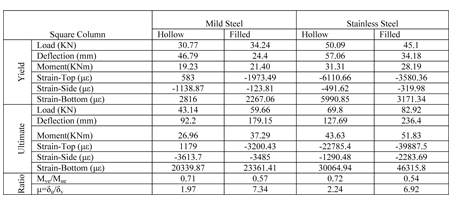
Table 3: Summary of the impact test results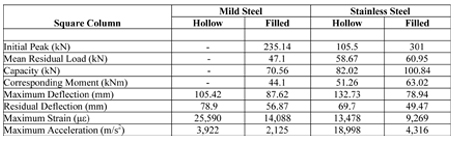
The dynamic increase factor is defined as the ratio of the moment capacity of the member under the impact loading and the static loading. A summary of the dynamic increase factors are provided in Table 4.
Table 4: Experimentally calculated dynamic increase factors
This paper has investigated the capacity of hollow and concrete filled mild steel and stainless steel sections subjected to both static and impact loading with pre-compressive load. The results indicated adequate performance of concrete filled steel structures in terms of energy absorption and ductility, with stainless steel performing at a considerably higher capacity than mild steel. Concrete infill provided increased strength and ductility. Therefore the resistance to local buckling was enhanced by the use of concrete infill for both the stainless and mild steel sections. The use of stainless steel has benefited for impact loading due to their higher capacity and increased ductility. The results indicated that the hollow sections failed in local buckling well before global failure occurred, also the effect of concrete infill in both mild and stainless steels greatly enhanced resistance to local buckling. The numerical model is being developed to validate existing experimental data.
Keywords: Concrete-filled steel tube (CFST); Stainless steel; Impact loading; Pre-compressive load; Dynamic increase factor; Split Hopkinson’s bar.