
| doi:10.3850/978-981-08-6218-3_CC-Fr040 |
 Final Paper PDF Final Paper PDF
|
A SIMPLIFIED DESIGN METHOD FOR COMPOSITE FLOOR BEAMS WITH WEB OPENINGS IN FIRE
V. Y. Bernice Wong1,a, Ian W. Burgess1,b and Roger J. Plank2
1Department of Civil and Structural Engineering, University of Sheffield, Sheffield S1 3JD, UK.
av.wong@sheffield.ac.uk
bian.burgess@sheffield.ac.uk
2School of Architectural Studies, University of Sheffield, Sheffield S10 2TN, UK.
r.j.plank@sheffield.ac.uk
EXTENDED ABSTRACT
Web-openings in a beam result in loss of strength, and significantly reduce the flexural capacity of the beam. A web opening produces an additional (Vierendeel) effect across the length of the opening due to the vertical shear forces at the ends of the opening. This can result in the formation of four plastic hinges at the “corners” of an opening. Equally, shear forces transferred across the web-posts between openings can result in local buckling of these web-posts. In the event of fire, the rapid loss of strength and stiffness of structural steel will significantly influence the capacities of the composite perforated section. In recent years, fire engineering design guidance has been issued for composite beams with circular web openings. However, this guidance has been limited to beams with circular web openings which are critical in web-post buckling. In this paper, a simplified design method representing the Vierendeel mechanism for composite floor beams with rectangular web-openings subjected to fire is presented.
Vierendeel bending resistance across an opening depends on composite action of the upperflange section and concrete slab. This significantly increases the resistance to Vierendeel bending. Where partial shear connection exists, the force in the concrete slab is limited by the number of shear connectors placed between the support and the centre of the opening. In the event of fire, the total Vierendeel resistance (Mv,Rd,fi) is defined as:
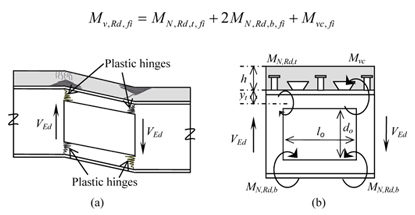
Figure 1: Vierendeel mechanism (a) Mode of failure; (b) Vierendeel bending around web opening.
In this MN,Rd,t,fi and MN,,Rd,b,fi are the plastic bending resistances of the top-tee and bottom-tee of the perforated section. Mvc,fi is the bending resistance due to local composite action between the top-tee section and the concrete slab, which depends on the number of shear connectors placed above the opening.

where:
| ns,o | is the number of shear connectors provided above the opening. |
| PRd,fi | is the design shear resistance of a shear connector at high temperature. |
| hc | is the overall depth of the concrete slab. |
| xc | is the thickness of concrete in the compressive zone. |
| yt | is the distance of the neutral axis of the steel top-tee section from the top-flange. |
Validation of the simplified model is made by comparing the prediction with finite element simulation and the results obtained from a full-scale fire test. The test specimen contained rectangular web-openings with relatively wider web-posts and a thick web section to induce Vierendeel mechanism. The figures below illustrate the type of failure mode predicted by the FE modelling and observed from the fire test. They show good agreement in terms both of failure modes and overall behaviour. Vierendeel action developed in the regions of the openings in both the FEA model and the fire test. The limiting temperature predicted by the proposed simplified method shows good but slightly conservative agreement with both the FE model and the furnace test.
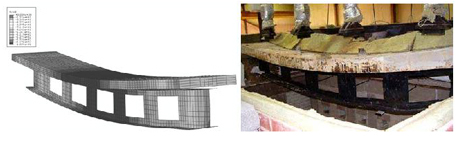
Figure 2: Beam behaviour in FE and test
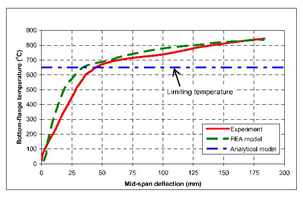
Figure 3: Furnace temperatures and mid-span deflection against time