
| doi:10.3850/978-981-08-6218-3_CC-Fr039 |
 Final Paper PDF Final Paper PDF
|
NUMERICAL MODELLING OF RESTRAINED STRUCTURAL SUBASSEMBLIES OF STEEL BEAM TO CFT COLUMN IN FIRE
Sherif Elsawafa, Y. C. Wangb and P. Mandalc
School of Mechanical, Aerospace and Civil Engineering, University of Manchester.
aSherif.Elsawaf@postgrad.manchester.ac.uk
bYong.Wang@manchester.ac.uk
cParthasarathi.Mandal@manchester. ac.uk
This paper employs the general finite element software ABAQUS to numerically model the behaviour of restrained structural subassemblies of steel beam to concrete filled tubular (CFT) columns and their joints in fire. An important feature of the modelling is the ability to trace the transitional and catenary action behaviour of the steel beam at very large deflections. This paper will present results of comparison between the simulation and test results for one of the fire tests recently conducted at the University of Manchester using reverse channel connection. The transitional behaviour of the beam from compression to catenary action presents particular difficulties in numerical simulations due to the extremely high rate of deflection increase. To overcome this problem, a pseudo damping factor was introduced in ABAQUS simulation. It is important that this pseudo damping factor is not too high to render the simulation results inaccurate, but not too low so that its use to overcome numerical difficulty is made ineffective. This paper will present how to select an appropriate pseudo damping factor. This paper will also present the results of sensitivity studies on finite element mesh.
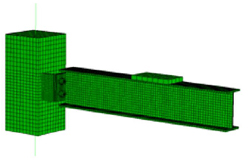
Three-dimensional solid elements (C3D8) were used to model the main structural members. The tested structure was symmetrical in geometry. Therefore, to save computational time; it was decided to include only half of the test assembly in the finite element model. Furthermore, to reduce the number of elements and nodes in the FE model, the column was divided into three parts and only the central part connected by the joint and exposed in fire in the furnace was actually modelled using the solid elements. The other two parts away from the joint zone were modelled using general beam elements. The ABAQUS “Coupling” function was used to join the three column parts. Figure 1 shows a typical finite element mesh for the structure assembly. A series of ABAQUS models were built and run to assess the sensitivity of simulation results to the FE mesh. The reduction factors for strength and elastic modulus of carbon steel at elevated temperatures provided in EC3 (EN 1993-1-2) were used. The ABAQUS contact function was used to simulate the interaction between the contact pairs. In order to reduce the computational cost, a contact was defined as surface to surface contact with a small sliding option. “Hard contact” was assumed for the normal contact behaviour and a friction coefficient of 0.3 was used in the tangential direction of the contact pairs. As in the test, the FE modelling applied the loads in two steps: (i) two point loads were applied to the beam at ambient temperature; (ii) while maintaining the structural loads, the structural temperatures were increased until the end of the fire test.
Detailed results of comparison between the finite element models and the test results for the 10 tests conducted at the University of Manchester will be presented in another paper. Due to space limitation, this paper will only show the results for one test. Figure 2 compares the modelling and experimental results for the deformed shapes of the beam and the joint. Figure 3 compares the measured and simulated beam axial force and beam mid-span deflection as functions of the beam lower flange temperature at mid-span.
 |
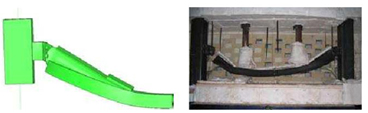 |
Figure 1: Typical FE model |
Figure 2: Behaviour and failure mode of test 4(reverse channel connection) |
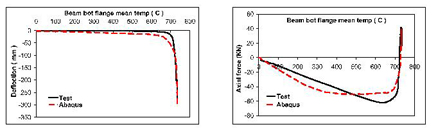
Figure 3: Comparison of modeling and experimental results for axial force and mid-span deflection in the beam restrained by reverse channel joints (Test 4)
The transitional behaviour of the beam from compression to catenary action presents particular difficulties in numerical simulations due to the extremely high rate of deflection increase. To overcome this problem, a pseudo damping factor was introduced in ABAQUS simulation. In this paper a series of ABAQUS models for every test were built and run to select the proper dissipated energy fraction in order to tackle the non-convergence problem but producing the least effect on the structural behaviour. It is important that this pseudo damping factor is not too high to render the simulation results inaccurate, but not too low so that its use to overcome numerical difficulty is made ineffective. In the absence of experimental information, the appropriate damping factor may be selected by comparing the applied loads with the reaction forces. The reaction force should be in static equilibrium with the applied load. However, if the structure experiences instability, the artificial damping may contribute to resisting the applied load, causing the reaction force to be lower than the applied load. If the instability is temporary, the damping effect should decrease and the reaction force should return to the level of the applied load. However, if the instability is genuinely caused by structural failure, the artificial damping will continue to be effective and the reaction force will continue to decrease.
From this paper the following conclusions may be drawn
1. If an appropriate damping factor is used, the ABAQUS/Static solver has the ability to model very large structural behaviour at high temperatures.
2. The proposed finite element models give very good agreement with the experimental results and observations.
3. Whether or not a damping factor is appropriate may be assessed by comparing the reaction force with the applied load. If the reaction force falls below the applied load but then returns to the applied load, it may be considered that the drop in reaction force is caused by temporary loss of stability in the structure. If the reaction force falls below the applied load but continues to do so, then the structure should be considered to have failed.