
| doi:10.3850/978-981-08-6218-3_CC-Fr036 |
 Final Paper PDF Final Paper PDF
|
AN EXPERIMENTAL STUDY ON THE LONGITUDINAL SHEAR RESISTANCE OF COMPOSITE SLAB WITH CLOSED-TYPE DECK
Yuan-Qing Wanga, Jong-Su Sungb and Yong-Jiu Shic
Department of Civil Engineering, Key Laboratory of Civil Engineering Safety and Durability of China, Education Ministry, Tsinghua University, Beijing 100084, China.
awang-yq@tsinghua.edu.cn
blmsjs79@163.com
cshiyj@tsinghua.edu.cn
EXTENDED ABSTRACT
In order to primarily inspect the shear bond behavior of the flat-type composite deck slab an experimental study has been carried out for this inspection. According to the general provisions in Eurocode4, total 18 composite slab specimens were manufactured to evaluate the m, k values. These specimens were split into three groups. Each group was divided into two sets, and one set had three specimens to be examined for shorter shear span, the other set was set for longer shear span. Each group of specimens was manufactured to have different thickness from others for a parametric study, which was 115, 150, and 200mm each. As the experimental result, it is found out that the evaluated design equation based on Eurocode4 is similar to the tested data. The test results are summarized as end-slip, deformation, and strength capacity of each set of specimens.
1. INTRODUCTION
Composite slab floor system is the most widely used in steel framed building. The strength of composite slab is mainly controlled by the longitudinal shear resistance between steel deck and concrete. But the composite behavior between them is very complex and difficult to evaluate mathematically, thus all existing designs of composite slab and the methods of analyzing them merely rely on experimental methods. In this paper, in order to primarily inspect the ultimate strength and longitudinal shear bond behavior for the new flat-type composite slab, an experimental study has been carried out for the test based on the m-k method in Eurocode4 and ASCE.
2. DEVELOPMENT OF TEST SPECIMEN AND TESTED RESULT
New flat-type steel deck, ECONDEK 65-675, is used in this test, total 18 composite slab specimens,, were made to evaluate the m-k values. Each group of specimen was manufactured to have different thicknesses for a parametric study; 115, 150, and 200mm each. The horizontal slip was measured through electronic dial gauges around the support. All loading processes are presented by Eurocode 4. At the loading point, the vertical crack has been found in the long span specimens, and the diagonal crack in the short span specimens . Also, the local buckling of steel deck was near to this loading point . Because there was no stud bolt at the end of slab, the horizontal slip occurs. In short span specimen, especially, explicit separation was found.
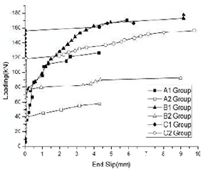
From the shear bond-end slip curves, some of specimens, especially thicker slabs, was shown as the brittle behavior, and the maximum end slip tends to increase with increase in slab depth.
From the deflection behavior of both short span and long span, the thin slab group more clearly shows distraction in the specimens of the short and long span.
After a cyclic loading, all specimens are proved to have residual deflection. it can be pointed out that the residual deflection is caused by chemical bond failure between the concrete slab and the steel deck.
 |
 |
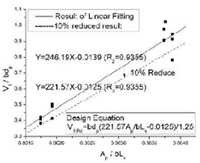 |
Figure 1: End slip curves |
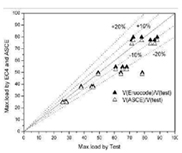
Figure 2: Comparison of max. loads |
Figure 3: m-k curve by design Eq. |
4. ANALYTICAL RESULT
To determine the ultimate longitudinal shear resistance of composite slab, which is the main purpose of this experimental study, the recommended design equation is based on Eurocode4 and ASCE.
It is pointed out that the design equation based on the Eurocode4 is closer to the tested data than the method of ASCE in this test. Thus, the design equation is evaluated from Eurocode4 method.
3. CONCLUSIONS
From the test program result, all type of slab show the longitudinal failure behavior. It points out that the shear stud is essential for the real use-age stage to determine ultimate strength of composite slab.
The m, k value related to longitudinal shear resistance and design equation for ECONDEK65-675 steel deck is obtained through this test program, it can be used for reference data of other similar steel decks.
According to the testing conditions for the m, k design method, the results can involve large errors to the same steel deck. Thus it is essential to use generally approved testing methods by design code, etc. to avoid trial and error in the testing and developing stage for a new steel deck.