
| doi:10.3850/978-981-08-6218-3_CC-Fr033 |
 Final Paper PDF Final Paper PDF
|
EXPERIMENTAL AND ANALYTICAL INVESTIGATIONS OF MOMENT-CURVATURE-TEMPERATURE BEHAVIOR OF STEEL AND COMPOSITE BEAM-COLUMNS AT ELEVATED TEMPERATURE
J. A. Walz1,a, L. Choe2,c, A. Varma2,d and A. Surovek1,b
1Civil and Environmental Engineering, South Dakota School of Mines and Technology, Rapid City, South Dakota.
ajennifer.walz@mines.sdsmt.edu
bandrea.surovek@sdsmt.edu
2School of Civil Engineering, Purdue University, West Lafayette, Indiana.
clchoe@purdue.edu
dahvarma@purdue.edu
EXTENDED ABSTRACT
This paper presents the experimental and analytical research on the moment-curvaturetemperature (M-φ-T) behaviour of steel and composite columns at elevated temperature. Two series of experimental tests have been performed including concrete filled steel tube (CFT) and steel beam-columns. Each specimen was sequentially subject to: (i) constant axial loading, (ii) thermal loading on the plastic hinge region corresponding to the ASTM time-temperature (T-t) curve, and (iii) monotonically increasing flexural loading. The crosssection behaviour of beam-columns was examined by varying test parameters such as axial load levels, geometric and material properties of specimens, concrete strength, and temperature of steel.
An innovative testing methodology was implemented for both experimental tests. The use of radiant heaters, as apposed to traditional furnace testing, allows for more control in the application of thermal loads as well as greater variability of member testing. For instance, various structural loadings can be applied to a specimen in conjunction with thermal loading; whereas, few traditional furnace testing facilities are capable of applying any type of structural loading.
A 2D digital imaging system was developed to measure the displacement of the plastic hinge region. Major factors affecting the results obtained from this process are image resolution (number of rows and columns of pixels in an image), image definition (number of bits used to encode the value of pixels), the number of planes in an image (arrays of pixels representing the image — 1 for greyscale and 3 for colour images), contrast (difference in greyscale intensity between the target and background), perspective error (produced when the camera field of view is not perpendicular to the target), and distortion (optical error in the camera lens).
The fibre-based modelling algorithm was developed to predict the M-φ-T behaviours of tested specimens. The section behaviour of the heated cross-section of specimen was determined numerically incorporating the pre-determined temperature-dependent stressstrain (σ-ε-T) and thermal expansion (α-T) relationship for the steel and concrete fibre elements. 2D heat transfer analysis of the column cross-section was also performed to estimate the fibre element temperature. The analytical models compare reasonably, but the fibre-based models are slightly unconservative with the experimental results. The potential causes of this deviation would be the discrepancies in the steel and concrete material σ-ε-T and α-T models and the effect of confinement on composite cross-sections
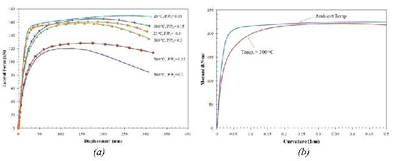
Figure 1: Calculated (a) lateral load-displacement-temperature (F-Δ-T) and (b) moment-curvature-temperature (M-Φ-T) response of W10x68 beam-columns
Sequentially coupled 3D finite element models were also developed to account for the various complexities of material behaviour including (i) geometric nonlinearity and secondorder effects, (ii) material nonlinearity and multiaxial material models with temperature dependence, (iii) composite interaction for CFT beam-columns, (iv) local buckling of steel members, and (v) loading and boundary conditions from the tests. The experimental results compare favourably with the overall behaviour and stress states predicted by 3D finite element analyses. Figure 1 (a) shows the force-deformation-temperature (F-Δ-T) response of W10X68 beam-columns. The figure indicates that the effect of axial load level is significant on the lateral F-Δ response when the surface temperature reaches to 500°C. At the same temperature, lateral load capacity degrades at the earlier stage of loading. Figure 1 (b) presents the calculated moment-curvature-temperature (M-Φ-T) response of the heated steel segment when the applied axial load (P/Po) is 0.3.
Work is currently in progress to adapt the fibre model for CFT to the bare steel beam. IN addition, a section constitutive finite element model is in development to apply the section characterization to a computationally efficient means of predicting overall frame behaviour under realistic thermal loads.