
| doi:10.3850/978-981-08-6218-3_CC-Fr032 |
 Final Paper PDF Final Paper PDF
|
PERFORMANCE OF SRC COLUMN TO SRC BEAM JOINTS SUBJECTED TO SIMULATED FIRE INCLUDING THE COOLING PHASE
T. Y. Song1,a, L. H. Han1,b, H. X. Yu1,c and B. Uy2
1Department of Civil Engineering, Tsinghua University, Beijing, P. R. China.
asty06@mails.tsinghua.edu.cn
blhhan@tsinghua.edu.cn
cYuHX@tsinghua.edu.cn
2School of Engineering, University of Western Sydney, Penrith South DC, Australia.
b.uy@uws.edu.au
EXTENDED ABSTRACT
This paper presents the experimental results of three steel reinforced concrete (SRC) column to SRC beam joints under combined actions of mechanical loading and fire heating, for which both a heating phase and a cooling phase have been considered. Temperatures and deformations of the joint specimens during the whole test procedure were measured. A finite element analysis (FEA) model was developed to simulate the behaviour of the tested joint under various complex loading states and the validity of the FEA model was verified as the predicted results show generally good agreement with the test results.
1. INTRODUCTION
This paper is an attempt to investigate the performance of SRC column to SRC beam joint during a complete fire that includes static initial loading, heating, natural cooling and post-fire resistance assessment. Three SRC column to SRC beam joint specimens were tested, and a finite element analysis (FEA) model was established to simulate the test. The FEA model was then used to investigate the relationship between the moment and the relative rotation between the SRC column and the SRC beam during all the phases.
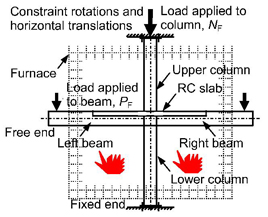
Figure 1: Schematic of the test setup
2. EXPERIMENTAL STUDY
SRC column to SRC beam joints, as shown in Figure 1, were tested under combined mechanical and thermal loading. The joints were loaded by applying loads on the column and the ends of the beam segments at ambient temperature. They were then heated according to the heating curve of the ISO-834 standard and cooled naturally with the mechanical loads maintaining constant. After the joint temperatures returned to room temperature, the load on the column was kept constant and loads on the beam were increased until the joint failed. The temperature distributions in the joints and the deformations of the column and beams in the heating, cooling and post-fire phases were recorded.
3. FINITE ELEMENT ANALYSIS (FEA) MODEL
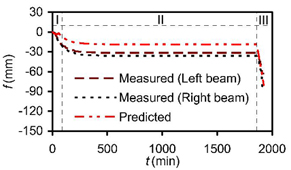
A finite element analysis (FEA) model was developed to simulate the behaviour of the tested SRC column to SRC beam joint by using the ABAQUS software. Heat transfer analysis was performed first to obtain the temperature field in the joint, and the deformation of the joint was then calculated in the mechanical model based on the input temperature field. The stress-strain models in ambient, heating, cooling and post-fire phases given by Song et al. were used in the FEA model. The developed FEA model was verified against the test results by comparing the failure modes, the joint temperature distribution and the specimen deformation. Figure 2 shows a comparison of the measured and the predicted beam deflection (f) versus time (t) curves, where I, II and III represent the heating, cooling and post-fire phases, respectively.
 |
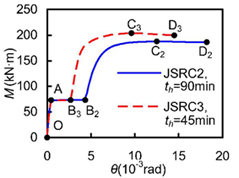 |
Figure 2: f–t curve of beam |
Figure 3: M–θ curves of joint specimens |
4. TYPICAL MOMENT VERSUS RELATIVE ROTATION RELATION
Figure 3 shows the predicted moment (M) versus the relative rotation (θ) between SRC column and the SRC beam for the complete loading phases. In the figure, O-A represents the ambient phase A-B2 (A-B3) represents the heating and cooling phases, in which, θ increases due to the deformation of column and beam, but M remains unchanged. B2-C2-D2 (B3-C3-D3) represents the post-fire phase. In this phase, the beam loads are increased until the joint fails and C2 (C3) is the peak moment. By comparing the M–θ curves of specimens JSRC2 and JSRC3 in Figure 3, it can be seen that, as the heating time increases, the peak moment decreases, but the rotation needed to reach the peak moment increases.
5. CONCLUSIONS
This paper reported three tests carried out on SRC column to SRC beam joints under combined loading and fire actions including cooling. A finite element analysis model was established to simulate the SRC joint tests. Finally, typical relationship between the moment and the relative rotation between SRC column and SRC beam was analyzed using the FEA model. The FEA model can be used for the further parameter analysis.