
| doi:10.3850/978-981-08-6218-3_CC-Fr031 |
 Final Paper PDF Final Paper PDF
|
EXPERIMENTAL AND ANALYTICAL STUDY ON CHANNEL SHEAR CONNECTORS IN LIGHT WEIGHT AGGREGATE CONCRETE
Mahdi Shariati1,a, N. H. Ramli-Sulong1,b, Shervin Maleki2 and M. M. Arabnejad.KH1,c
11Department of Civil Engineering, University of Malaya, 50603 Kuala Lumpur, Malaysia.
ashariati@perdana.um.edu.my
bhafizah_ramli@um.edu.my
carabnejad_mm@perdana.um.edu.my
22Department of Civil Engineering, Sharif University of Technology, Azadi Ave., Tehran, Iran.
smaleki@sharif.edu
EXTENDED ABSTRACT
In this paper, the capacity of channel shear connectors embedded in normal and light weight aggregate concrete (LWAC) are investigated through experimental and analytical studies. Limited push-out test is used to measure the accuracy of a proposed nonlinear finite element model for typical push-out test specimens. Using this model, an extensive parametric study is performed to arrive at a prediction for shear capacity of channel connectors in LWAC concrete. An equation, for inclusion in design codes, is suggested for the shear capacity of these connectors when used in LWAC concrete.
EXPERIMENTAL PROGRAM
Five push-out specimens with different mix proportions were considered for testing in this study
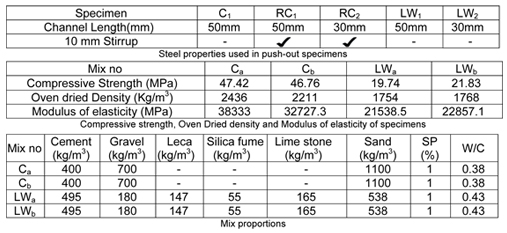
The applied load per channel versus relative displacement between the steel beam and the concrete slabs is shown for the specimens under monotonic loading.
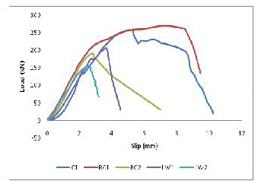 | 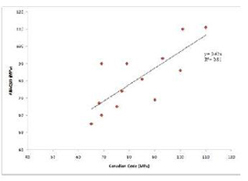 |
Figure 1: Load-slip curve results of monotonic push-out test | Figure 2: Result of FE analysis versus Canadian code. |
straight line can be fitted through the data with reasonable accuracy. The slope of this line is about 0.62 and is less than one so the code over predicts the capacity of channel shear connectors embedded in PP concrete without stirrups Hence, by applying the coefficient of 0.61 to the code's equation one can obtain a good estimate of this capacity in LWAC concrete. Eq. below shows the modified version of the code equation as it applies to shear capacity of channels embedded in LWAC concrete. The standard deviation of the suggested equation is 6.95:

Where: Qn is nominal strength of one channel shear connector (N), tf is flange thickness of channel shear connector (mm), tw is web thickness of channel shear connector (mm), Lc is length of channel shear connector (mm), fc is specified compressive strength of concrete (MPa)
CONCLUSIONS
A series of monotonic push-out tests were performed on normal and LWAC concrete with channel shear connectors. Also, a nonlinear finite element model of the push-out test was developed in ABAQUS software. Experimental results show that 1: The composite system, when channel shear connectors are embedded in unconfined normal concrete, has a brittle behavior.2: Using stirrups in concrete blocks of push-out tests increases the shear capacity and ductility of the composite system.3: The shear capacity of normal concrete with confining stirrups is close to the value given by the Canadian code and is used to calibrate the FE model.4: The shear capacity of channel shear connector is less in lightweight aggregate concrete compared to normal and Poly propylene concrete. For unconfined concrete and LWAC concrete, the shear capacity is lower than the Canadian code equation. The shear capacity of these channels is estimated with reasonable accuracy to be 21% lower than the ones embedded in normal confined concrete as predicted by the Canadian code equation. The revision to the Canadian code equation is suggested for the capacity of channel connectors embedded in LWAC concrete.