
| doi:10.3850/978-981-08-6218-3_CC-Fr029 |
 Final Paper PDF Final Paper PDF
|
STATIC AND DYNAMIC BEHAVIOUR OF NON-COMPOSITE STEEL-CONCRETE-STEEL PROTECTIVE PANELS UNDER LARGE DEFORMATION
A. Remennikov1,a, S. Y. Kong1,b and B. Uy2
1School of Civil, Mining and Environmental Engineering, University of Wollongong, Wollongong,
NSW.
aalexrem@uow.edu.au
bksy965@uow.edu.au
2School of Engineering, University of Western Sydney, Penrith, NSW.
b.uy@uws.edu.au
EXTENDED ABSTRACT
Steel-concrete-steel (SCS) panels are an effective means for protecting critical infrastructure facilities from the effects of external detonations. Existing designs of SCS panels utilise composite action between the core concrete and the external steel plates which requires mechanical or adhesive connections. This paper presents an experimental programme of research in which the steel skin does not act compositely with the concrete core. High effectiveness in resisting blast and impact loads is achieved through special detailing of the flared end connections that provide axial fixity as well as restraining the relative movement between the concrete core and the external steel plates.
The design concept for protective barriers utilising non-composite SCS panels is based on the two major criteria: 1) high effectiveness in resisting effects of close-range high explosive (HE) detonations and high-speed vehicle impacts, and 2) economical viability and time effective installation procedures. Three major components in this protective barrier concept are: 1) the non-composite SCS panel with the external steel plates, 2) the flared end connections, and 3) effective supporting structure. Non-composite SCS panels were chosen due to their high energy absorption capability and promising economic and technological characteristics. Imparted energy is dissipated by axially stretching the steel faceplates and crushing the concrete core. Furthermore, no hazardous projectiles will be generated since the faceplates confine the concrete core. The concrete core mass provides inertial effects which are beneficial for resisting of the impulsive loading by the barrier. The overall cost of construction is reduced by not providing shear connectors between the faceplates and effective manufacturing techniques. A simple yet effective keyed connection is used to connect the panels to the supporting structural elements. The connection has sufficient axial and rotational stiffness and provides the axial fixity to enable the tensile membrane action in the panels under large deformation.
The experimental programme described in this paper utilised model test panels having the dimensions shown in Figure 1(a). The top and bottom faceplates were bent into the required shape to produce flared ends The end plates were then welded to the flared ends to produce partially enclosed steel shell. The key inserts used for creating a keyed connection were fabricated using same steel plates as those used in the panel fabrication. The geometry and dimensions of the key inserts are shown in the Figure 1 (b).
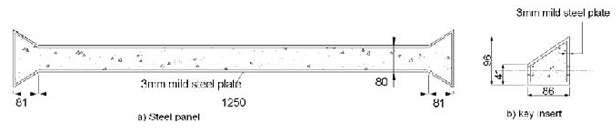
Figure 1: Geometry and dimensions for (a) SCS panel, (b) key insert
Static and dynamic responses of non-composite SCS panels are presented in Figures 2 and 3. Analysis of the results of tests on model non-composite steel-concrete-steel panels has demonstrated the viability of utilising the axial fixity to significantly enhance resistance against extreme loading events. Non-composite form of SCS panels with axial restraints can provide an attractive solution for the expedient construction of high-performance barriers for the protection against close-range blast threats and severe impact events.
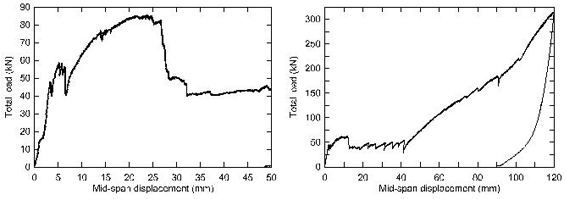
Figure 2: Static responses of: (a) simply supported panel with mild steel faceplates, (b) panel with axial
restraints
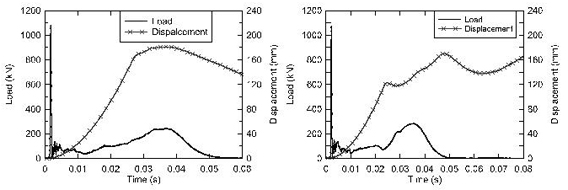
Figure 3: Impact responses for panels with axial restraint: (a) mild steel faceplates (b) mild and stainless steel
faceplates