
| doi:10.3850/978-981-08-6218-3_CC-Fr026 |
 Final Paper PDF Final Paper PDF
|
ULTIMATE LOAD BEHAVIOUR OF COMPOSITE PLATE GIRDERS WITH TRAPEZOIDALLY CORRUGATED WEBS
M. Basher, N. E. Shanmugama and A. R. Khalim
Department of Civil and Structural Engineering, National University of Malaysia, 43600 UKM Bangi, Malaysia.
ashan@vlsi.eng.ukm.my
1. INTRODUCTION
Ultimate load behaviour of horizontally curved composite plate girders with trapezoidally corrugated webs is examined in this paper. The effect of such webs on the ultimate load carrying capacity of steel girders is investigated first and, the composite action of such girders when acting with concrete deck studied thereafter. Finite element software LUSAS is used in the study. Results are presented for different types of girders in terms of ultimate load carrying capacity, load-deflection behaviour and buckling patterns in the webs. Effect of openings in the webs is also considered in the study.
2. ANALYSIS OF PLATE GIRDERS WITH TRAPEZOIDALLY CORRUGATED WEBS
Five groups of girders were considered in the analyses. In the first group five horizontally curved steel plate girders, ST1, ST2, ST3, ST4 and ST5 with flat width bh of the corrugation equal to 20mm, 100mm, 300mm, 500mm and 750mm, respectively, were studied. Thickness of the corrugated webs was chosen as 8.53 mm. The flange slenderness (bf/2tf), in accordance with the recommendations by AASHTO, was taken as 11.94. The overall depth of the girders was 1.22 m whilst the top and bottom flanges of 22.9 mm thick were taken as 546.6 mm wide. The chord length for all the girders was kept as 11.58 m with nominal radius of 63.63 m.
The second group consisted five composite girders, CT1, CT2, CT3, CT4 and CT5 corresponding to the steel girders ST1, ST2, ST3, ST4 and ST5, respectively. To each of the five steel girders, concrete slab of 200 mm thick and 2400mm wide was added at the top flange to act compositely with the steel part. Full interaction in the composite action was assumed. The girders in groups G3 and G4 were considered in order to examine the effect of corrugation depth on the ultimate load behaviour and shear capacity. Composite girders CT6, CT7, CT8, CT9 and CT10 formed the group G3 in which the flat width bh and angle of inclination β of the corrugated webs were kept 500 mm and 45°, respectively, with the corrugation depth, h varied as 100mm, 200mm, 300mm, 400mm and 500mm. In these girders, length, ‘a’ and hence its projected length, dtz of the inclined part of the corrugations change with the corrugation depth. In group G4 the girders CT11, CT12, CT13, CT14 and CT15 were formed by varying the corrugation depth, h from 100 mm to 500 mm with bh and β values fixed at 500mm and 90°, respectively.
Effect of web openings was also investigated by analysing another set of girders in which the composite girder CT5 with corrugation flat width, bh of 750 mm was chosen as the reference girder. Circular openings were placed in the flat part of the corrugation with the diameter of the openings varying from 0.1D to 0.5D, D being the girder depth.
3. RESULTS AND DISCUSSION
Load-displacement plots are presented for the girders in Figures 1 and 2. It is clear from the figure that all girders with corrugated webs generally results in enhanced shear capacity and stiffness compared to the girder S1 with plain webs stiffened transversely. Observation similar to that made in the case of steel girders could also be made in the composite girders. Variation of ultimate shear capacity with corrugation depth is summarized in Figure 3 for the two groups of the girders. The increase in shear capacity appears to become significant as the corrugation depth is increased. The ability of the corrugated web to resist higher shear capacity becomes more pronounced when the angle of corrugation is kept 90°. The effect of opening size on the ultimate shear capacity of the girder CT5 is shown in Figure 4 in which the shear capacity is plotted against the ratio of opening size and girder depth. It is obvious from the figure that the larger opening results in significant drop in the shear capacity of the girder compared to openings of smaller size. Results for girder C1 non-corrugated web containing circular openings are also shown in the figure for comparison.
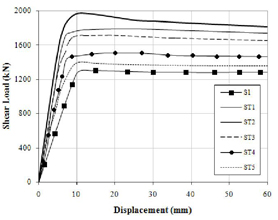 | 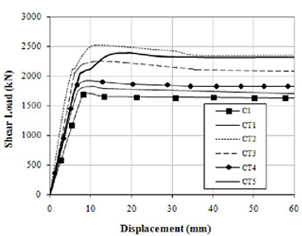 |
Figure 1: Load-displacement plots for steel girders | Figure 2: Load-displacement plots for composite girders |
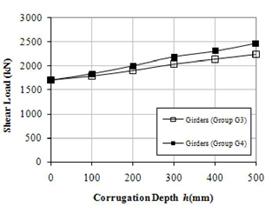 | 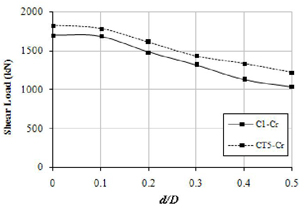 |
Figure 3: Variation of ultimate shear capacity with corrugation depth in composite girders | Figure 4: Effect of web opening size on shear capacity of girder CT5 |