
| doi:10.3850/978-981-08-6218-3_CC-Fr025 |
 Final Paper PDF Final Paper PDF
|
OPENINGS IN SANDWICH PANELS
F. Warmutha and J. Langeb
Institute for Steel Structures and Material Mechanics, Technische Universität Darmstadt, Germany.
awarmuth@stahlbau.tu-darmstadt.del
blange@stahlbau.tu-darmstadt.de
EXTENDED ABSTRACT
Sandwich panels with flat or lightly profiled faces often form the façade of a building. Due to different requirements like windows, doors or ducts, it is necessary to cut openings into the face of a building. These openings reduce the load bearing capacity of sandwich panels. At present, openings in sandwich panels require an additional substructure, which transfers the loads to the main structure. These replacements lead to additional assembly work and are often optically not wanted. The aim of the project is to find possibilities and to develop calculation models to avoid this kind of substructure. Depending on the size of the opening, different measures are possible.
If the opening lies in a lower stressed part of the panel or the size of the opening is very small, the panel can carry the load without any kind of substructure. For these cases there already exist calculation models. If the panel is not able to carry the load, it has to be strengthened. Therefore one solution is a supporting frame, which is integrated in the opening and diverts the loads around it. Also additional profiles – integrated in the joints - can be used to increase strength and stiffness of the panel and to reduce the stress concentration in the corners of the openings. For large openings and openings across the longitudinal joint it is necessary to include the neighbouring elements in the load transfer. Therefore, detailed information on the rigidity and load capacity of the longitudinal joint and the torsional rigidity of the panels are needed.
Firstly test results for single elements and element formations with strengthened openings are presented. Also test results for the bearing capacity of the longitudinal joints are shown. All these tests are part of the European research project EASIE (www.easie.eu). The long-term objective is to generate a calculation model for sandwich elements with different kind of strengthening. This model should be only dependent on parameters which can be derived from some basic tests. The EASIE project has received financial support from the European Community’s Seventh Framework Programme FP7/NMP2-SE-2008 under grant agreement No 213302.
1. SUMMARY OF THE PAPER
In recent years, some research projects on openings in sandwich panels were conducted. In all the publications, only openings without any kind of strengthening were discussed. In this project, panels with window frames and the bearing capacity of longitudinal joints for a load transfer to neighbouring elements have been tested.
In a first test series sandwich panels with a window at midspan have been tested in a six point bending test. The results of test series 1 show that window frames have a positive effect on the load bearing capacity of single sandwich elements with openings. Table 1 shows a comparison with existing calculation models for frameless openings.
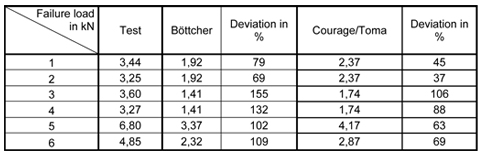
Table 1: Comparison of the failure load in kN between test and calculation
The failure load can be clearly increased in comparison to panels with frameless openings. Nevertheless, for large openings the loss of bearing capacity is very high.
In a second test series an interconnection system with 3 sandwich panels and a window in the middle panel has been tested. The window opening had the width of a complete panel. The entire load had to be transferred to the outer panels. The maximum loads in the second series varied within a wide range. The main reason for that was evidently the slipping of the window frames out of the joints. As the slipping is a question of an exact fabrication of the window it can be avoided. For the bearing strength of the joint, in prior publications only a rough estimate is given. That could be another reason for significant deviations between some of the test results and the recalculation by existing calculation models.
As a result of the significant deviations, a series of tests on different longitudinal joints was planned.
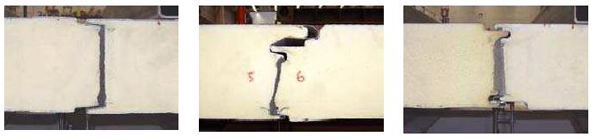
Figure 1: Geometries of the tested longitudinal joints
The tests showed no explicit correlation between the allowable shear stresses of the panels and the bearing capacity of the joints. Existing calculation formulas for the bearing capacity could not be confirmed. When a load transfer is necessary, it is recommended to determine the bearing capacity of the joint always by tests.