
| doi:10.3850/978-981-08-6218-3_CC-Fr019 |
 Final Paper PDF Final Paper PDF
|
STUDY ON COMPRESSION-FLEXURE MEMBERS OF STEEL TUBE FILLED WITH STEEL-REINFORCED HIGH-STRENGTH CONCRETE
X. Liu1,a, L. G. Wang2 and B. Wang1
1School of Architectural and Civil Engineering, Shenyang University, Shenyang, China.
aliuxiao19740701@sina.com
2School of Resources & Civil Engineering, Northeastern University, Shenyang, China.
wangbing616@163.com
1. INTRODUCTION
A steel tube filled with steel-reinforced high-strength concrete(STHSRC) is a new kind of composite member made by inserting steel skeletons into the steel tube before injecting the tube with high-strength concrete. Not only does it share the virtues of concrete filled steel tube members and steel-reinforced concrete members, it also demonstrates other merits. On one hand, internal steel skeletons are constrained by the outlying concrete, preventing the steel skeletons from local buckling. Therefore, the steel skeletons have increased the shear-bearing capacity and seismic ductility of the composite members. On the other hand, the steel tubes impose constant constraint on the concrete, protecting it from lateral deformation for the concrete is in the state of three-directional stress. The compressive strength of concrete is thus improved. So is the seismic ductility of high-strength concrete. Although its prominent mechanical properties are best displayed in axial compression, there are few members that only endure axial compression in engineering practice. Members such as the upper columns of the step columns used in single-story industrial plants, and the frame columns of the boiler house in power plants not only endure axial compression, but also endure bending moment, thus enabling members to work under compression-flexure. Presently, some scholars have studied some mechanical capacity of STHSRC on cross-shaped steel skeleton, which have established the foundation for researches on the new kind of composite members. This paper mainly researches on the compression-flexure capacity of such members with built-in I-shaped steel skeletons. It also discusses the influence of different axial compression ratios and loading directions on properties such as bearing capacity and deformation. Using the N-M relationship method, the formula for calculating the compression-flexure bearing capacity of STHSRC is also established.
2. EXPERIMENTAL DESIGN
This research covers five compression-flexure specimens. Experimental parameters are axial compression ratios (n0 ) and loading directions (major axis and minor axis). After the manufacture of the specimen, fix it on the positive electrode method with a grip, with the grip connected with lateral bracing by a roll to make both ends of the specimen stable under horizontal load. Connected with a lifting jack through a 500-ton transducer; horizontally, it is connected to a lifting jack through a 200-ton transducer. During the process of loading, the strain of the specimen is measured by horizontal and vertical gages, and the deformation of the specimen is measured by the laterally laid displacement meter.
3. EXPERIMENTAL ANALYSIS
By analyzing on the typical curve of load and deformation, curve demonstrates three stages. The first, in elastic stage, external load P increases in proportion to deformation um . The second, in elastic-plastic stage, P - um visibly shifts from the original straight line, and the increase speed of the load gradually lessens. The third, in disruption stage, part of the concrete gradually stops functioning. Here, the length of the stage with elastic characteristic is related with preloading axial force, and the curve of disruption stage is concerned with axial compression ratio.
By testing the longitudinal strains of composite column’s sections, show that the specimens remain plane section deformation throughout the loading process, however, as the load increases, the neutral axis shifts toward the compressive zone. The distance of shift is related with the axial compression – the larger the axial compression ratio, the further the neutral axis moves away from the central axis and the closer to the tensile region.
By analyzing the influence of axial compression ratio on the bearing capacity, it shows that there is no linear proportion between the rate of decrease of the bearing capacity and the rate of increase of the axial force. On the contrary, the rate of decrease enlarges as the axial compression ratio increases. It also indicates that axial compression ratio is of little influence to the limited load’s corresponding amount of deflection.
By analyzing different loading directions, the limited bearing capacity of specimen with loading conducted along the minor axis is lower than that of specimen whose loading is conducted along the major axis. The descending part of the graph shows that the double confining force on the concrete, formed by the flange of steel skeleton and the steel tube, is stronger than the force of web of steel skeleton for it prohibits the damage on the specimen.
4. CALCULATION OF BEARING CAPACITY
Through theoretical calculation, it can be seen that the relation curve  of
of
STHSRC agrees with the cubic parabolic curve, which is now simplified into double-fold line. By the regression analysis of statistics to coefficient ( η0 and ξ0 ), we can get the formula of the bearing capacity of strength:
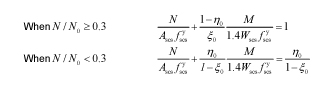
It can be drawn that there is a concordant between their values. The mean value, drawn from comparing the limited bearing capacity and measured value, and discrete parameter are 1.17 and 0.058. However, the applicability of the formula is yet to be tested with further researches.