
| doi:10.3850/978-981-08-6218-3_CC-Fr017 |
 Final Paper PDF Final Paper PDF
|
AN EVALUATION OF THE STEEL-CONCRETE INTERACTION OVER THE COMPOSITE FLOORS DYNAMIC RESPONSE
A. V. De A. Mello1,a, J. G. Santos Da Silva2,c, S. A. L. De Andrade1,b, P. C. G. Da S. Vellasco2,d, L. R. O. De Lima2,e
1Pontifical Catholic University of Rio de Janeiro, PUC-Rio, Brazil.
amello@gmail.com
bandrade@puc-rio.br
2State University of Rio de Janeiro, UERJ, Brazil.
cjgss@uerj.br
dvellasco@uerj.br
elucianolima@uerj.br
EXTENDED ABSTRACT
The increasing incidence of building vibration problems due to human activities led to a specific design criterion to be addressed in structural design. This was the main motivation for the development of a design methodology centred on the composite floors dynamical response submitted to dynamic loads due to human activities. On the other hand, the competitive trends of the world market have long been forcing structural engineers to develop minimum weight and labour cost solutions. A direct consequence of this new design trend is a considerable increase in problems related to unwanted floor vibrations. For this reason, the structural floors systems become vulnerable to excessive vibrations produced by impacts such as human walking activities.
A first approximation geometry of the human body walking is a straight-leg motion that necessarily causes the main body mass to rise and fall at every step. This rise and fall is typically about 50mm, peak to peak, but is sensitive to the leg angle at full stretch, and thus to the extent to which the walker forces the pace. The present investigation was carried out based on a more realistic loading model developed to investigate the composite floors dynamical response incorporating the dynamical effects induced by people walking.
The leg movement can be modelled as an ascent and descending movement of the human body effective mass at each step while dynamical loading position changes according to the individual position. The generated time function, corresponding to the excitation induced by people walking, has, in this loading model, a space and time description.
The main objective of this paper is to investigate the influence of steel-concrete interaction degree (from the complete to various levels of partial interaction degrees) over the composite floors dynamic behaviour subjected to human walking loads. The investigated structural model was based on building composite floors and consisted of a typical office building interior bay. The structural system was composed of a composite (steel-concrete) solution made of an “I” steel profile and a reinforced concrete slab, as presented in Figure 1.
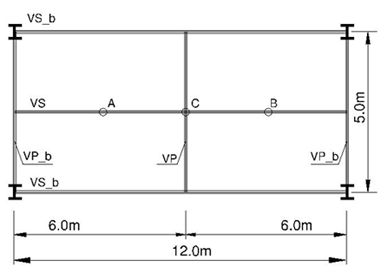
Figure 1: Investigated structural model
The proposed computational model, developed for the composite floor dynamic analysis, adopted the usual mesh refinement techniques present in finite element method simulations implemented in the ANSYS program. In this computational model, floor steel girders were represented by three-dimensional beam elements, where flexural and torsion effects are considered. The composite slab was represented by solid finite elements. The present investigation considered that both materials (steel and concrete) have an elastic behaviour. The computational model is illustrated in Figure 2.
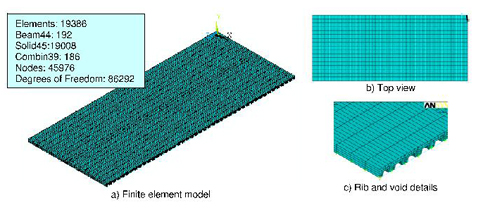
Figure 2: Composite floor finite element model mesh and layout
When the complete interaction between the concrete slab and steel beams was considered in the analysis, the model coupled all the nodes between the beams and slab, to prevent the occurrence of any slip. On the other hand, to enable the slip between the concrete slab and the “I” steel profiles, to represent the partial interaction (steel-concrete) cases, the modelling strategy used nonlinear spring elements simulating the shear connector actions. The adopted shear connector force-displacement curves were based on experiments.
An extensive parametric study was developed focusing in the determination of the influence of the steel-concrete partial interaction degree over the composite floor dynamic response. The structural system peak accelerations were compared to the limiting values proposed by several authors and design standards. In this investigation, the maximum value found for the acceleration was equal to 1.14m/s2 (ap = 1.14m/s2), while the maximum accepted peak acceleration values was equal to 0.05m/s2 (alim = 0.05m/s2). The results obtained in this investigation indicated that the investigated composite floor violated the human comfort criteria, as well as its vibration serviceability limit states.