
| doi:10.3850/978-981-08-6218-3_CC-Fr014 |
 Final Paper PDF Final Paper PDF
|
THE STABILITY STUDY ON STEEL-CONCRETE COMPOSITE PLATES
Nie Jianguo1,a, Li Faxiong1,b and Wu Lili2
1Civil Department, Tsinghua University, Haidian District, Beijing, China.
aniejg@tsinghua.edu.cn
bLifaxiong@gmail.com
2School of Architecture & Civil Engineering, China University of Mining And Technology, Haidian District,
Beijing, China.
Wull03@mails.tsinghua.edu.cn
EXTENDED ABSTRACT
Steel-concrete composite plates are formed using steel plates connected to a concrete slabs by means of welded stud shear connectors, shown in Figure 1.
The flexible studs cause the slip of the interface and make the composite plate bending curvature and the deformation increase. A method is proposed to deal with elastic behaviour of composite plates. It is assumed to place a hypothetical thin shear-layer between steel and concrete slabs to simulate slip effect of composite plates, shown in Figure 2.
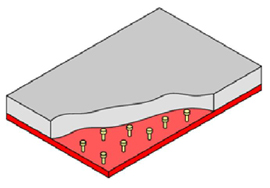 | 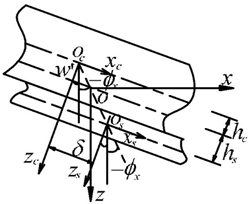 |
Figure 1: Steel-concrete composite plates | Figure 2: Composite plate interface slip effect |
In this paper, buckling behaviours of simply supported rectangular composite plate under axial compression and pure shear are discussed. The boundary conditions of simply supported rectangular composite plate considering slip effect as follow.

The basic equation of simply supported rectangular composite plate considering slip effect under axial compress loads is as follow.

Then, the critical buckling load of the composite plate can be obtained.

The basic equation of simply supported rectangular composite plate considering slip effect under pure shear is as follow

After iterative calculation, the shear buckling load of simply supported rectangular composite plate can be approximately obtained.

According to Galerkin’s method, the critical buckling load of the composite plate under pure shear can be obtained.

Where, ksz is the Shear buckling coefficient of simply supported rectangular composite plate. Three-dimensional finite element analysis model is established. Both concrete slab and steel plate use solid element to simulate. Z-direction displacements of all points on the interface are coupled and the spring element represents anti-slip stiffness provided by shear studs. The FEM model and buckling modals are show as Figure 3.
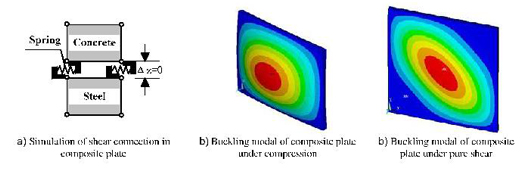
Figure 3: FEM modelling of composite plates
Figure 4 shows the variation of critical buckling load upon the shear stiffness of the shear-layer. It is shown that the results of finite element analysis and theoretical model match well and the maximum deviation is 5.6%. Hence, the correctness and applicability of theoretical model of Steel-concrete composite plate in this paper are proved.
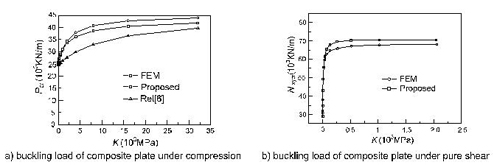
Figure 4: The critical buckling loads of composite plate upon shear stiffness in the interface