
| doi:10.3850/978-981-08-6218-3_CC-Fr002 |
 Final Paper PDF Final Paper PDF
|
A MACRO-MODEL FOR BEAM-TO-COLUMN CONNECTIONS IN STEEL-CONCRETE COMPOSITE FRAMES
C. Amadio1,a, M. Bella1,b and L. Macorini2
1Department Civil & Environmental Engineering, University of Trieste
aamadio@units.it
bbella@dica.units.it
2Department Civil & Environmental Engineering, University of Trieste
l.macorini@imperial.ac.uk
EXTENDED ABSTRACT
The paper presents an advanced macro-model for steel-concrete composite joints (Figure 1a). The model, based on the component method, is capable of accurately predicting both the monotonic and cyclic behaviour of beam-to-column joints. Moreover it can be included in frame models to assess, with high precision, the seismic performance of composite frames with partial resistant beam-to-column connections.
With respect to former component-based formulations for composite joints, in the proposed modelling approach, a detailed representation of the cyclic behaviour of the main resistant components is assumed. Specific hysteretic laws, characterized by strength and stiffness degradation, are used. They have been calibrated considering the results of experimental component tests. The interaction between columns and concrete slab is modelled accounting for the two main resistant mechanisms suggested by Eurocode 8 (mechanism type 1 and 2 in Figure 1b) and considering the contribution of confined and unconfined concrete independently.
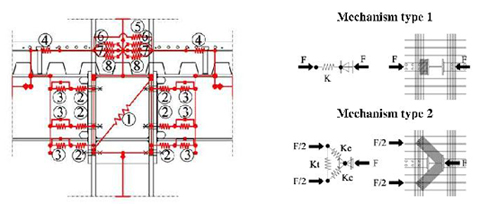
Figure 1: (a) Proposed macro-model and (b) resistant mechanisms for slab-column interaction.
In Figure 1a the proposed macro-model for a bolted end-plate composite beam-to-column connection is shown. The component represented by the spring No. 1 corresponds to the web panel in shear. The smooth hysteretic model developed by Kim & Engelhardt, which accounts for both bending and shear deformations, is used for modelling the elastic and plastic response. The component modelled by the spring No. 2, represents beam and column webs in tension and/or transversal compression. A trilinear hysteretic law with kinematic hardening is used to model the hysteretic behaviour. It corresponds to a polygonal hysteretic model which does not consider any strength and stiffness degradation and it is characterized by an asymmetrical trilinear loading curve. Spring No. 3 corresponds to a T stub element for the end-plate and the column flange in bending. A specific nonlinear curve is used, which has been defined on the basis of recent experimental results on T-stub specimens. The proposed relationship is asymmetric; in compression the response is rigid, while the opening in tension is modelled by a curve with hardening and deterioration of strength and stiffness. Five nonlinear springs, No. 4-5-6-7-8 in Figure 1a, are employed to model the slab and the interaction between slab and column. The spring No. 4 models the shear connection in the composite beam. A symmetric trilinear curve and the pivot degradation rule developed by Park et al. are used to model the cyclic behaviour. The spring No. 5 represents the longitudinal reinforcement bars and the concrete slab in tension. An asymmetric trilinear curve with no degradation has been employed. The spring No. 6 accounts for mechanism type 2 for slab-column interaction, which corresponds to a strutand- tie mechanism with inclined struts against the column and transversal reinforcing bar ties (Figure 1b). Finally, springs No. 7-8 model mechanism type 1, which corresponds to confined and unconfined concrete layers in compression (Figure 1b). Again an asymmetric trilinear curve for modelling the monotonic response and the pivot rule for representing the hysteretic behaviour has been considered.
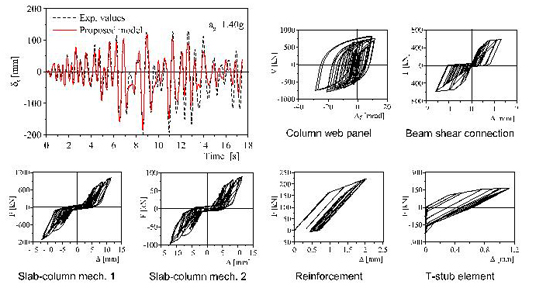
Figure 2: Numerical analysis of a composite frame under seismic loading: experimental-numerical comparison
of the frame lateral displacements time-history and local response of some joints components.
The accuracy of the proposed modelling approach for composite joints has been checked in experimental-numerical comparisons. The cyclic behaviour of composite joints and on the response of a whole composite frame under lateral loading have been analysed.
In Figure 2, some results achieved in the numerical analysis of the composite frame under seismic loading are shown. They confirm the good agreement between experimental and numerical curves and the effectiveness of the proposed macro-model in assessing local damage in the main joints components, even in the case of seismic loading.