
| doi:10.3850/978-981-08-6218-3_BUS-We044 |
 Final Paper PDF Final Paper PDF
|
FINITE ELEMENT RESPONSE SENSITIVITY ANALYSIS OF STEEL FRAMES EQUIPPED WITH BUCKLING-RESTRAINED BRACES
A. Zona1,a, L. Ragni2 and A. Dall’asta1,b
1University of Camerino, Ascoli Piceno, Italy.
aalessandro.zona@unicam.it
bandrea.dallasta@unicam.it
2Marche Polytechnic University, Ancona, Italy.
laura.ragni@univpm.it
EXTENDED ABSTRACT
This work focuses on response sensitivity analysis of steel frame structures equipped with BRBs within a displacement-based finite element formulation. A realistic 4-storey steel frame equipped with buckling-restrained V-bracings systems is used as benchmark problem. Selected sensitivity analysis results are shown for quantifying the effect and relative importance of design cross section areas of BRBs in regards to the nonlinear dynamic response under seismic ground motions of the benchmark structure.
EXTENDED ABSTRACT
Concentrically braced frames are efficient seismic resistant systems offering high-lateral stiffness for drift control and dissipating earthquake-induced energy by the diagonal bracing members only, not a part of the gravity resisting frame. However, the energy dissipation capacity of concentric braces is strongly reduced by brace buckling. Buckling-restrained braces (BRBs) represent a major improvement compared to conventional braces in terms of dissipation capacity being buckling prevented. Nevertheless, this kind of brace is still prone to damage concentration at certain stories, especially in steel frames with beams connected to columns by means of pinned joints. As a result, the frame global ductility is strongly dependent on the distribution of BRB strength at each storey level. FEMA 450 seismic provisions considers BRBs as a particular kind of braces and suggests for their design linear analysis methods, i.e., equivalent lateral force and response spectrum procedures with appropriate force reduction factors. The area of the yielding segment of the BRB steel core is expected to be determined in order that its yield strength is fairly close to the demand, thus preventing undesirable concentrations of inelastic deformations in few stories only. In Eurocode 8 only conventional braces are considered and the maximum difference in brace over-strength (defined as the ratio between the actual and the design areas) is recommended to be limited to 25% for all diagonals, to obtain a homogeneous dissipative behaviour. As a matter of fact, the ductility distribution in multi-storey frames with conventional or buckling-restrained braces depends on various factors (e.g., design method, brace over-strength distribution, elastic elements able to redistribute plastic deformations) and requires proper evaluation. In this issue, response sensitivity analysis is a very useful methodology to accurately evaluate the effect of brace areas distribution on storey damage parameters. Moreover, sensitivity analysis represents an essential tool in gradient-based optimization as well as in probabilistic response analysis and structural reliability. It is recalled that if r is a response quantity (displacement, strain or stress related) and θ a sensitivity parameter (geometric, material or loading parameter), the sensitivity of r with respect to θ is expressed, by definition, as the derivative of r with respect to θ evaluated at θ = θ0 where θ0 denotes the reference value taken by the sensitivity parameter.
This work focuses on response sensitivity analysis of a benchmark 4-storey steel frame with pinned beam-column connections and equipped with buckling-restrained (Figure 1 a, b), designed with the modal response spectrum method according to Eurocode 8.
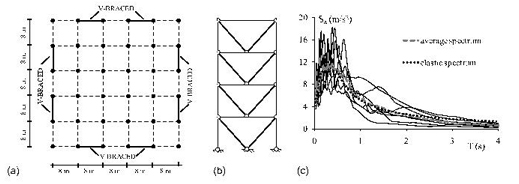
Figure 1: (a) Floor configuration; (b) bracing configuration; (c) pseudo-acceleration spectra of the selected ground
motions and relevant average spectrum compared to the elastic spectrum.
The behaviour of the designed bracing system was studied through time history analyses considering seven natural ground motions (Figure 1c) from the European strong motion database. Response sensitivities of the vector of interstorey drifts (damage parameters), assumed as response quantity r of interest, were computed with respect to the independent sensitivity parameters θk = Ak (k = 1, 2, 3, 4), where Ak is the cross section area of the BRBs at the k-th floor. Time history response and response sensitivity results are strongly influenced by the earthquake ground motion considered. However, if attention is limited to the sensitivities of each interstorey drift when its peak drift is attained, comparable results follow from the seven seismic inputs considered. The results obtained are summarized in Figure 2 where the response sensitivities of |ii|(at the time of its peak) with respect to Ak are averaged over the seven earthquakes considered. The results allow the quantification of the increments and decrements of interstorey drifts due to the sensitivity parameters Ak, with insight on their relative importance.
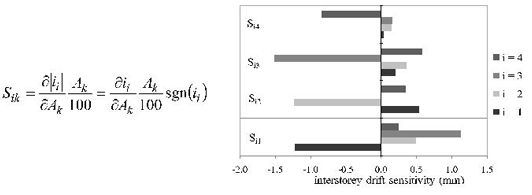
Figure 2: Normalized sensitivity of interstorey drift at peak interstorey averaged over seven earthquakes.