
| doi:10.3850/978-981-08-6218-3_BUS-We040 |
 Final Paper PDF Final Paper PDF
|
NUMERICAL STUDY OF BEHAVIOR OF AXIALLY LOADED STEEL COLUMNS SUBJECTED TO TRANSVERSE IMPACT
H. Al-Thairya and Y. Wangb
School of Mechanical, Aerospace and Civil Engineering, Faculty of Engineering and Physical
Sciences, The University of Manchester, Manchester, UK.
aHaitham.bady@postgrad.manchester.ac.uk
byong.wang@manchester.ac.uk
EXTENDED ABSTRACT
In this research, the validity and reliability of using the commercial finite element software ABAQUS/Explicit to numerically simulate the response of axially pre-compressed steel columns subjected to transverse impact is established through selection of appropriate ABAQUS modelling parameters, including geometrical, material, and impact load modelling parameters. The simulation results, in terms of the contact force generated by the transverse impact, deformation histories are compared with available test results on axially loaded columns with transverse impact. The comparison results give confidence in the numerical simulation results. Using the validated simulation methodology, a limited numerical parametric study has been conducted to investigate the effect of several dynamic and geometrical parameters: the impact energy; the values of the axial compressive load; the slenderness ratios of the impacted column and the location of the impact on the response of axially compressed steel columns subjected to transverse impact.
VALIDATION OF NUMERICAL SIMULATION AND PARAMETRIC STUDY
The validation of the present numerical simulation of the transverse impact of the axially compressed column was carried out by a comparison with the experiment test conducted by Zeinoddini et al. It has been shown that the present simulation results are in very good agreement with the experimental results, Figure 1(A). This agreement between present results and experimental results can be accounted for the accuracy of the present simulation conditions. The present authors’ simulation results were compared with numerical simulation of Zeinoddini et al using ABAQUS/implicit, Figure 1(B). The comparison showed that the present simulation gives more realistic results than Zeinoddini et al.
Afterward, a parametric study is conducted using simply supported steel columns with circular hollow section (406.4 ×25) mm (diameter × thickness). According to BS 5950: Part 1:1990, a 10 metre column has a maximum axial compressive resistance of 6290 kN. The aim of this parametric study is to understanding of the effects of different parameters on column behaviour and failure modes which help to make the suitable simplifying assumptions when developing design calculation methods.
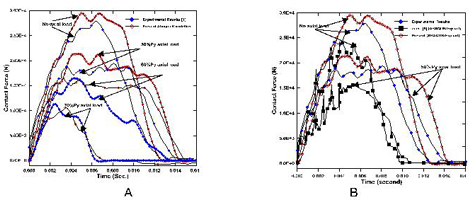
Figure 1: Comparison between the present numerical simulation and experimental and numerical results of Zein.
It can be noticed from Figure 2(A) and 2(B) that when the axial load level is moderate (45% column design strength) and the impact energy below the critical energy level (approximately 80%), the impact energy is the governing factor that controls column failure. This assumption is the starting point of the quasi-static approach based on energy balance.
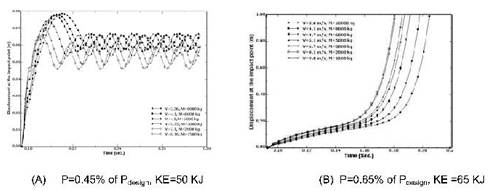
Figure 2: Behaviour of the axially loaded steel column under same impact energy with different combinations of
impactor mass and velocity
The results of the numerical parametric study have also shown that the presence of the axial pre-loading affects the behaviour of the transversely impacted steel column (Figures 3(A) and 3(B)). Therefore, a safe and rational analytical method such loading conditions must be able to distinguish the effects of different axial load levels
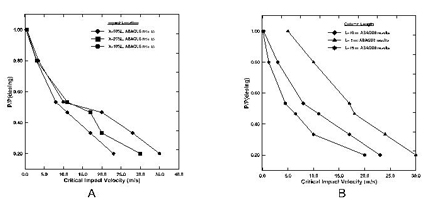
Figure 3: Effect of the impact location, (A) and the slenderness ratio, (B) on the column critical axial load –
impact velocity relationship